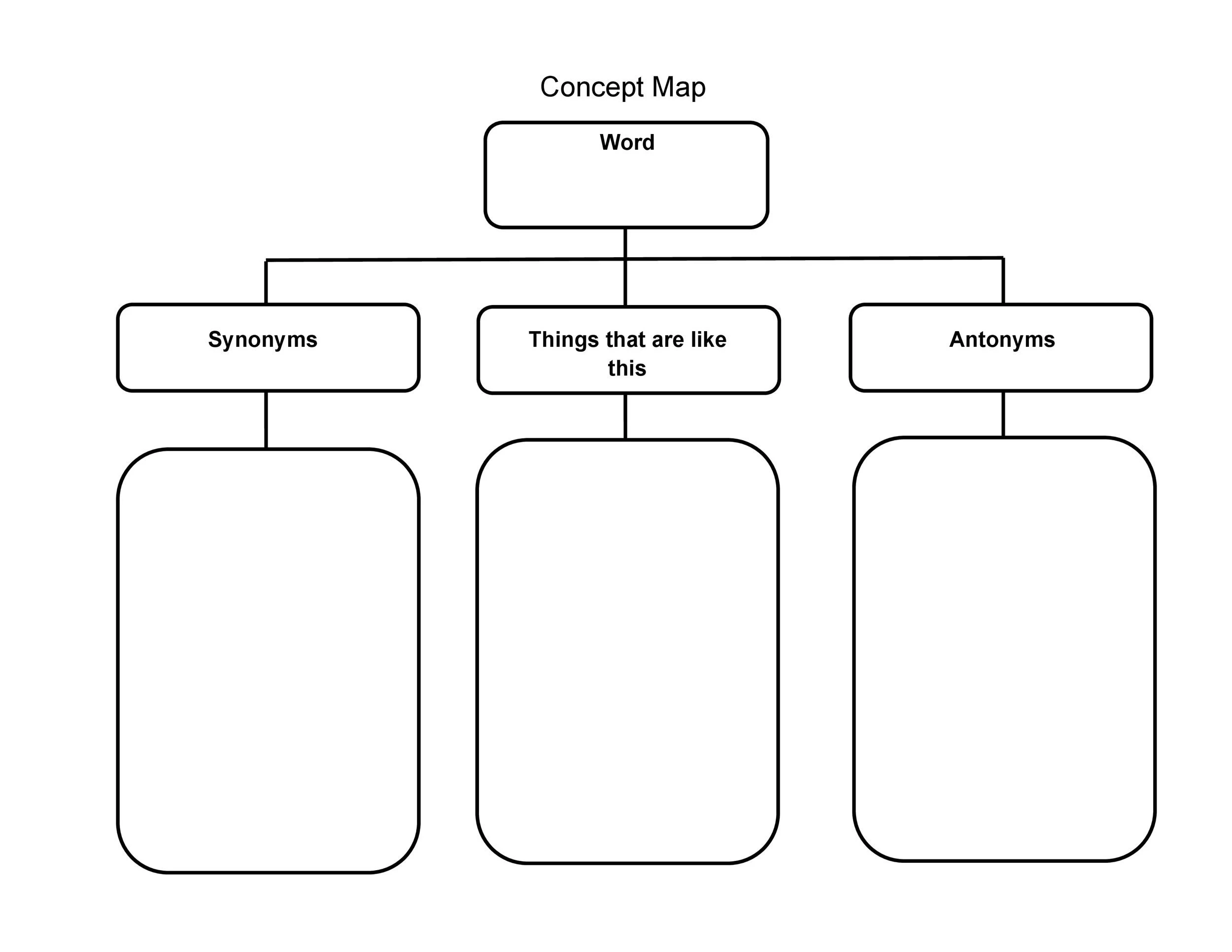
Concept maps are powerful tools that visually represent knowledge and the relationships between concepts. They help learners organize information, identify connections between ideas, and understand complex topics in a more holistic way.
Concept mapping is a versatile tool used in various settings, from education to problem-solving and knowledge management.
What is a Concept Map?
A concept map is a visual representation of relationships between concepts. It consists of nodes, which represent concepts, and links, which connect the nodes to show relationships.
Concept maps can be simple or complex, depending on the depth of knowledge being represented.
What is The Purpose of a Concept Map?
The main purpose of a concept map is to help learners organize and represent knowledge in a structured way. By visually mapping out concepts and their relationships, learners can see the big picture and how different ideas are interconnected. This facilitates deeper understanding and retention of information.
Benefits of Using Concept Maps
Concept maps offer several benefits for learners and knowledge management:
- Facilitates understanding: Concept maps help learners see the relationships between concepts, making complex topics easier to comprehend.
- Promotes critical thinking: By creating concept maps, learners engage in higher-order thinking skills such as analyzing, synthesizing, and evaluating information.
- Enhances memory retention: Visual representations are easier for the brain to remember compared to text-only information.
- Aids in problem-solving: Concept maps can be used to brainstorm ideas, identify solutions, and create action plans for tackling challenges.
- Encourages collaboration: Concept maps can be shared and revised collaboratively, fostering teamwork and collective knowledge building.
Types of Concept Mapping
Different types of concept mapping techniques cater to various learning styles and purposes:
- Spider Concept Maps: A central node represents the main concept, with branches extending outward to related sub-concepts.
- Hierarchical Concept Maps: Concepts are arranged in a top-down structure, showing the relationship between main ideas and sub-ideas.
- Flowchart Concept Maps: Concepts are linked in a linear sequence to illustrate processes or workflows.
- Network Concept Maps: Concepts are interconnected in a web-like structure, showing complex relationships between multiple ideas.
- Storyboard Concept Maps: Concepts are arranged in a visual narrative format, ideal for storytelling or sequential learning.
Component of Concept Maps
A typical concept map consists of the following components:
- Nodes: Represent individual concepts or ideas.
- Links: Connect nodes to show relationships, such as cause and effect, similarity, hierarchy, or sequence.
- Labels: Provide descriptions or explanations for nodes and links.
- Colors and Shapes: Used to visually differentiate between different types of concepts or relationships.
- Key: Includes a legend or key to explain the symbols and colors used in the concept map.
The Applications of Concept Maps
Concept maps are widely used in various fields for different purposes:
- Education: Teachers use concept maps to introduce new topics, assess student understanding, and facilitate learning activities.
- Business: Companies use concept maps for strategic planning, process improvement, team collaboration, and knowledge sharing.
- Healthcare: Healthcare professionals use concept maps for patient education, treatment planning, and medical research.
- Research: Researchers use concept maps to organize literature reviews, develop research proposals, and visualize complex theories.
- Project Management: Project managers use concept maps to define project scope, identify stakeholders, track progress, and communicate project goals.
Concept Map Template – Free Download
