A History Timeline is a visual way to arrange important events in chronological order. Instead of reading dates and events from a long list of notes, students, teachers, researchers, and history enthusiasts can use a timeline to see how events unfolded over time. This simple format makes historical information easier to understand, compare, remember, and explain.
From ancient civilizations and major wars to scientific discoveries, political developments, cultural movements, and family history, a timeline can turn complicated information into an organized visual story. When designed carefully, a historical timeline does more than show dates. It helps reveal relationships, sequences, turning points, causes, and long-term changes.
What Is a History Timeline?
A History Timeline is a chronological representation of historical events. Events are arranged according to when they happened, usually from the earliest date to the latest date. Each point on the timeline can include a date, event title, short description, image, location, or other relevant information.
A timeline can cover a very broad period, such as world history, or focus on a narrow subject, such as the history of a country, civilization, invention, war, or historical figure.
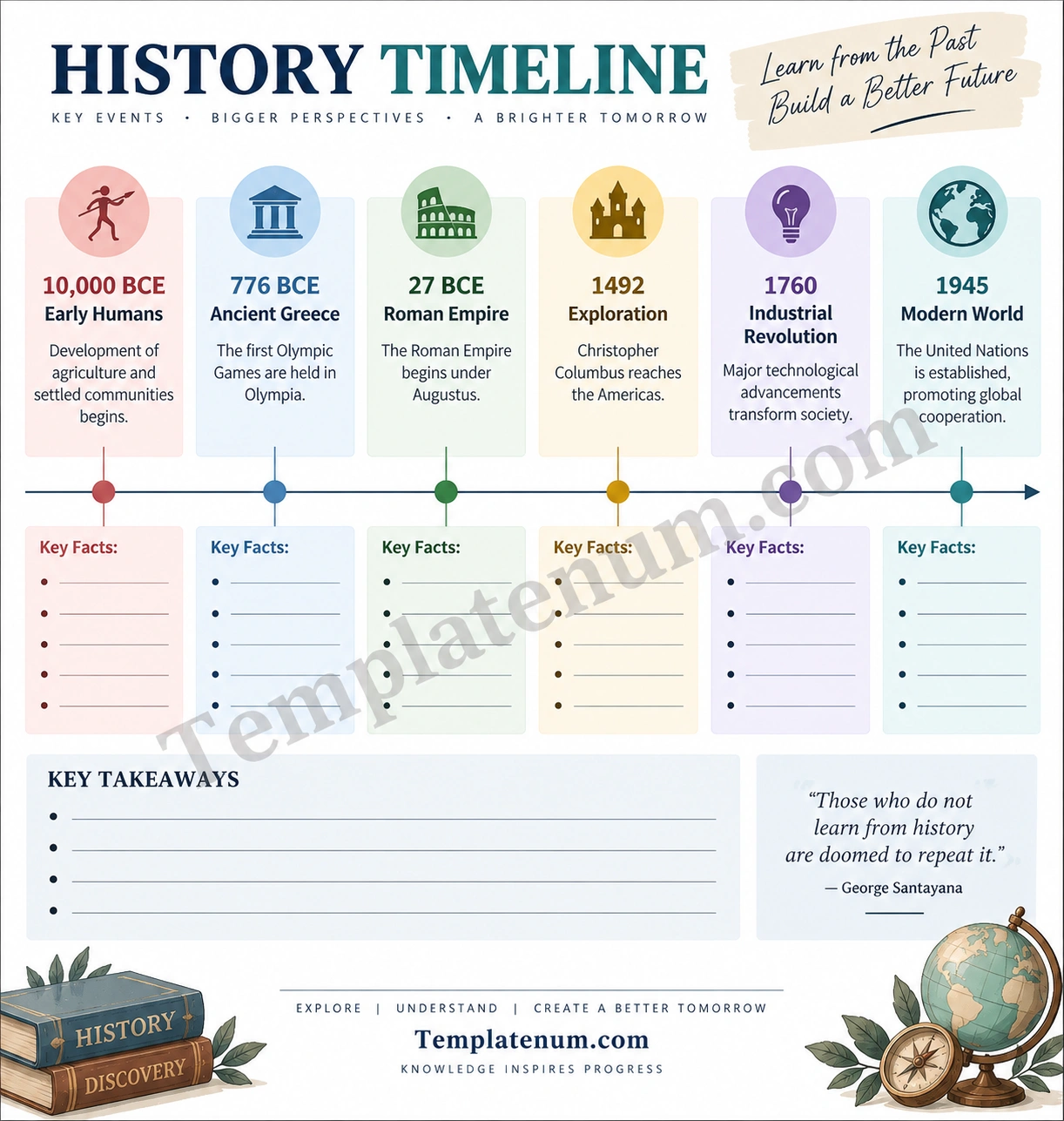
Typical elements of a historical timeline include:
- Date or time period: Shows when an event occurred.
- Event title: Identifies the historical event or development.
- Description: Provides important context or details.
- Timeline marker: Shows the position of the event chronologically.
- Visual elements: Images, icons, maps, or illustrations can reinforce important information.
- Key facts: Additional details can help explain why an event matters.
Why Use a Historical Timeline?
History involves many dates, people, places, and interconnected events. A timeline provides a structure that makes this information easier to process. It allows readers to quickly identify what happened first, what happened later, and how much time passed between major developments.
A chronological timeline can be particularly useful for education because visual organization can complement traditional reading and note-taking. Students can use timelines when studying a historical period, preparing for an examination, or completing a classroom project.
Other benefits include:
- Making historical information easier to review.
- Showing the chronological sequence of events.
- Helping identify important turning points.
- Making long periods of history easier to understand.
- Supporting classroom presentations and assignments.
- Helping compare events from different periods.
- Providing a visual reference for research projects.
- Making historical narratives more engaging.
Key Elements of an Effective History Timeline
Clear Dates
Dates are the foundation of a chronological timeline. Use consistent date formats and make sure each event is placed in the correct position. Depending on the subject, you may use exact dates, years, decades, centuries, or broader historical periods.
For ancient history, you may need to distinguish between BCE and CE. Consistency is especially important when a timeline covers a long period containing both BCE and CE dates.
Relevant Historical Events
Not every event needs to appear on a timeline. Select events that directly support the topic. Including too many minor details can make the timeline difficult to read and reduce attention on the most significant developments.
Choose events based on their historical importance, relationship to the topic, and usefulness to the intended audience.
Short Descriptions
Each event should have enough information to explain its significance without becoming a long paragraph. A concise description can identify what happened and why the event matters.
How to Create a History Timeline
Creating a useful history timeline starts with a clearly defined subject. Once the topic and time period are established, gather reliable information and organize the events before placing them into the visual layout.
1. Choose a Historical Topic
First, decide what the timeline will explain. A focused topic usually produces a clearer result than attempting to cover every event in a large historical period.
Possible topics include:
- Ancient civilizations
- World history
- U.S. history
- European history
- Military history
- History of science and technology
- History of an invention
- Life of a historical figure
- History of a country or region
- History of an organization or institution
2. Define the Time Period
Determine the beginning and ending points of your timeline. A timeline about the Industrial Revolution, for example, will have a different scope from a timeline about the entire history of human civilization.
Defining the time period helps prevent unrelated information from entering the project.
3. Research Important Events
Gather information from reliable historical sources. Record the dates, names, locations, and descriptions of important events. If the timeline is being used for academic work, keep track of your sources so that facts can be verified later.
4. Put Events in Chronological Order
Before designing the final timeline, arrange all events from earliest to latest. This step can reveal gaps, duplicated events, incorrect dates, or events that are not relevant to the selected period.
5. Add Context
A useful timeline should explain more than when something happened. Add a short description that provides context and identifies the significance of major events.
6. Review the Final Timeline
Check every date, spelling, name, and event description. Also review the visual spacing. The timeline should be easy to follow from beginning to end without requiring readers to search through crowded sections.
Types of History Timelines
World History Timeline
A world history timeline presents major developments across different civilizations and regions. Because world history covers thousands of years, it is often helpful to divide it into major periods or focus on selected events.
Historical Figure Timeline
This type of timeline follows the life and achievements of an individual. Important dates may include birth, education, major accomplishments, leadership positions, publications, discoveries, and death.
War History Timeline
A war timeline can show the sequence of major battles, political developments, treaties, military campaigns, and turning points. It can help readers understand how a conflict developed over time.
Ancient History Timeline
An ancient history timeline may cover civilizations, rulers, discoveries, migrations, conflicts, cultural developments, and major construction projects. Since historical records can vary by source, dates should be presented carefully when exact dating is uncertain.
Family History Timeline
A family history timeline organizes important family events chronologically. It can include births, marriages, migrations, education, careers, military service, and other significant milestones.
History Timeline Ideas for Students
Students can use timeline projects to explore historical subjects in a structured way. A timeline can be particularly useful when an assignment requires students to demonstrate how multiple events relate to one another.
Some useful history timeline project ideas include:
- Create a timeline of a major civilization.
- Map the major events of a historical war.
- Show the development of an important invention.
- Document the life of a historical figure.
- Compare important events from two historical periods.
- Create a timeline of major scientific discoveries.
- Show important milestones in the history of a country.
- Trace the development of a cultural or social movement.
For classroom projects, students can add images, maps, short quotations, or primary-source references to make the timeline more informative.
How to Make a Timeline Easy to Read
A timeline should communicate information quickly. Good organization is therefore just as important as historical accuracy.
- Use a clear chronological direction: Make it obvious where the timeline begins and ends.
- Keep descriptions concise: Highlight the most important information.
- Use visual hierarchy: Make dates and event titles easy to identify.
- Leave enough space: Avoid placing too many events in a small area.
- Group related information: Use consistent formatting for similar events.
- Highlight turning points: Give major events greater visual emphasis when appropriate.
- Maintain consistency: Use the same date and description format throughout the timeline.
Using a History Timeline Template
A History Timeline Template provides a ready-made structure for organizing historical information. Instead of spending time designing the basic layout, students and teachers can focus on researching events and writing meaningful descriptions.
A printable timeline template can be useful for classroom activities, homework, study guides, presentations, research projects, and educational displays. A template with clearly separated event areas also makes it easier to maintain consistency throughout the project.
When selecting a template, consider the number of events you need to include, the amount of writing space available, the historical period being studied, and whether you need additional sections for key facts or conclusions.
Digital vs. Printable History Timelines
Both digital and printable timelines can be useful. A digital history timeline is convenient when information needs to be updated frequently or when multimedia elements such as videos and hyperlinks are important.
A printable timeline, on the other hand, is useful for classroom worksheets, handwritten notes, study sessions, posters, and physical displays. It can also provide a simple way for students to sketch ideas before creating a more detailed digital project.
The best format depends on the purpose of the timeline and the needs of the audience.
Common Mistakes to Avoid
One common mistake is trying to include every event associated with a historical topic. A timeline becomes more useful when it emphasizes events that directly support its purpose.
Another problem is providing dates without context. Readers may remember a date but still not understand why the event was important. Short explanations can solve this problem.
Incorrect chronology is another issue to watch for. Always verify dates and arrange events carefully before finalizing the timeline. When historical dates are disputed or uncertain, acknowledge that uncertainty rather than presenting an approximation as an exact fact.
Finally, avoid creating a timeline that is so visually crowded that the information becomes difficult to read. Clear spacing and concise descriptions can significantly improve usability.
Tips for Using Timelines for Historical Research
Timelines can also be used as research tools rather than simply presentation materials. While researching a subject, create a working timeline and continuously add important events. This can help reveal connections that may not be obvious when information is stored in separate notes.
Consider recording the source of each important date or claim. You can also use different sections or visual markers to distinguish political, economic, cultural, scientific, or military developments when the topic includes several types of events.
After the research is complete, review the timeline and identify major periods of change. These patterns can help shape a research paper, presentation, lesson plan, or study guide.
Frequently Asked Questions About History Timelines
What is the purpose of a History Timeline?
The purpose of a History Timeline is to present historical events in chronological order so readers can understand their sequence, timing, relationships, and significance more easily.
What should be included in a history timeline?
A history timeline usually includes dates, event titles, short descriptions, and chronological markers. Depending on the project, it can also include images, locations, key facts, sources, and important takeaways.
How many events should a historical timeline have?
There is no fixed number. The appropriate number depends on the topic, time period, available space, and purpose. It is generally better to include fewer meaningful events than overcrowd the timeline with minor details.
Can a history timeline be used for school projects?
Yes. Timelines are commonly useful for history assignments, classroom activities, presentations, study guides, and research projects. They can help students organize information before presenting or writing about a historical topic.
Conclusion
A History Timeline is an effective way to organize historical information into a clear chronological structure. By combining dates, important events, concise descriptions, and visual organization, a timeline can make complex subjects easier to understand and review.
Whether you are studying ancient civilizations, researching a historical figure, preparing a classroom assignment, or documenting family history, a well-planned timeline can turn scattered information into a coherent visual story. Using a structured History Timeline Template can make the process even easier by providing a practical framework for research, organization, and presentation.
