An investment proposal is an essential document for businesses seeking funding to launch a new venture, expand operations, or develop a promising project. It presents a business opportunity to potential investors and explains why the investment deserves their attention. A strong proposal combines a clear business strategy, market research, financial projections, and a realistic plan for generating returns.
Whether you are a startup founder, small business owner, entrepreneur, or project manager, preparing a professional investment proposal can help you communicate your vision with confidence. Investors need more than an exciting idea. They want to understand the opportunity, evaluate the risks, and see how their capital will support measurable business goals.
This guide explains what an investment proposal is, which sections to include, and how to write a compelling document. You will also learn how to present financial information, demonstrate market potential, and avoid common mistakes when approaching potential investors.
What Is an Investment Proposal?
An investment proposal is a formal business document designed to persuade potential investors to provide funding for a company, project, or business opportunity. It explains the business concept, identifies the target market, outlines the growth strategy, and presents the expected financial performance.
The document also explains how the requested funds will be used and what investors may receive in return. Depending on the funding arrangement, this may involve equity ownership, interest payments, revenue sharing, or another agreed financial structure.
An investment proposal is commonly used by startups seeking seed capital, established businesses planning expansion, real estate developers, and entrepreneurs introducing new products or services. Although the format can vary, the objective remains the same: to demonstrate that the opportunity is credible, financially considered, and worth evaluating.
Why Is an Investment Proposal Important?
A well-prepared investment proposal helps investors understand a business before committing capital. It organizes essential information into a structured document that supports informed discussions and investment decisions.
1. Communicates the Business Opportunity
A proposal explains what the business does, which problem it solves, and why customers may choose its products or services. This gives investors a clear understanding of the business model and its potential advantages.
Rather than relying on broad claims, support your opportunity with market research, customer evidence, competitive analysis, and specific business objectives.
2. Demonstrates Financial Potential
Investors want to understand how a business expects to generate revenue and manage expenses. Financial projections help explain the expected performance of the business under stated assumptions.
Include realistic estimates for revenue, operating costs, cash flow, profitability, and funding requirements. Clearly distinguish historical results from forecasts, and avoid promising returns that cannot be supported by evidence.
3. Explains How Investment Funds Will Be Used
A funding request should identify the activities that require capital. These may include product development, equipment purchases, hiring, marketing, inventory, or market expansion.
Explain how each major expense contributes to specific business milestones. Investors can then assess whether the requested amount is appropriate for the proposed plan.
4. Builds Credibility and Trust
A professional proposal shows that the business owner has considered the market, financial requirements, operational challenges, and potential risks. It also provides a foundation for further due diligence.
Accurate information, transparent assumptions, and a clear funding structure can strengthen credibility. A polished design helps readers navigate the document, but reliable evidence is what makes the proposal persuasive.
What to Include in an Investment Proposal
The structure of an investment proposal depends on the business and the type of funding being requested. However, most proposals benefit from the following essential sections.
1. Executive Summary
The executive summary introduces the business and highlights the investment opportunity. It should explain the company’s purpose, the problem it addresses, its target market, and the amount of funding requested.
Include a brief overview of the business model, competitive advantage, growth potential, and expected use of funds. Keep this section concise so investors can understand the opportunity without reading the entire document first.
2. Business Overview
Describe the company, its products or services, and its current stage of development. Explain the business mission, operating model, and objectives for the next several years.
If the company is already operating, include relevant information about its history, customer base, sales performance, and major achievements. For a new venture, focus on the business concept, validation efforts, and launch plan.
3. Problem and Proposed Solution
Explain the customer problem or market need that creates the opportunity. Then describe how your product, service, or project addresses that need more effectively than existing alternatives.
Use customer feedback, research findings, pilot results, or other relevant evidence to support your claims. A clearly defined problem and practical solution make it easier for investors to understand the business’s value.
4. Market Opportunity and Competitive Analysis
Investors need to understand the market in which the business will operate. Identify the target customers, market size, relevant trends, and factors that may influence demand.
Also examine competitors and alternative solutions. Explain what differentiates your business, whether through pricing, technology, customer experience, distribution, expertise, or another defensible advantage.
A credible market analysis should rely on relevant sources and realistic assumptions. Avoid presenting the entire industry as your potential customer base without explaining how much of that market the business can reasonably reach.
5. Business Model and Revenue Strategy
Explain how the company will earn revenue and generate sustainable cash flow. Depending on the business, revenue may come from product sales, subscriptions, service fees, licensing, commissions, or recurring contracts.
Describe your pricing approach, sales channels, customer acquisition strategy, and expected cost structure. If the business has multiple revenue streams, explain how each contributes to overall performance.
6. Marketing and Growth Plan
Outline how the business will attract customers and expand its market presence. Include the main marketing channels, sales activities, partnerships, and milestones needed to achieve the proposed growth targets.
Connect these activities to measurable outcomes. For example, explain how a marketing budget supports customer acquisition or how a new distribution partnership increases access to a target market.
7. Management Team and Operations
Introduce the people responsible for executing the business plan. Highlight relevant experience, industry knowledge, technical skills, and previous achievements.
Describe the operational resources required to deliver the product or service. These may include employees, suppliers, technology, facilities, manufacturing capacity, or strategic partners.
8. Financial Projections
Financial projections show how the business expects to perform after receiving investment. Depending on the business stage, include forecasts for the next three to five years and explain the assumptions behind the estimates.
Consider including:
- Revenue forecast: Expected sales and the assumptions supporting growth.
- Operating expenses: Anticipated costs for staffing, marketing, rent, technology, and administration.
- Profit and loss forecast: Expected income, expenses, and profitability.
- Cash flow forecast: Expected cash inflows, outflows, and funding needs.
- Break-even analysis: Estimated sales or activity level needed to cover costs.
- Financial scenarios: Alternative outcomes based on different assumptions.
Make sure the projections are consistent with the marketing strategy, operating plan, and requested funding. Explain important assumptions and acknowledge uncertainties instead of presenting estimates as guaranteed results.
9. Investment Request and Use of Funds
State the amount of funding you are seeking and explain how the capital will be allocated. A clear breakdown helps investors understand the purpose of the request.
For example, funding may support product development, equipment, hiring, marketing, working capital, or expansion into new markets. Present the proposed allocation as amounts or percentages, and connect each category to a specific objective.
You should also explain the proposed investment structure. Depending on the opportunity, this may involve equity, debt, convertible financing, or another arrangement. The terms should be realistic and subject to appropriate legal and financial review.
10. Risks and Mitigation Strategies
Every business faces uncertainty. Address the most relevant risks, such as competition, changing customer demand, operational delays, regulatory requirements, supply chain problems, or cash flow constraints.
For each major risk, describe how the business plans to reduce its likelihood or impact. Demonstrating that you understand potential challenges can make your proposal more credible than ignoring unfavorable outcomes.
How to Write an Investment Proposal Step by Step
Writing a persuasive investment proposal becomes easier when you follow a structured process. Prepare the evidence first, then build a clear narrative around the opportunity.
Step 1: Define Your Funding Objective
Determine how much capital the business needs, why it is needed, and what the funding should achieve. Identify the milestones that the investment will help you reach.
A specific funding objective is more persuasive than a general request for money because it connects the investment to a practical business plan.
Step 2: Research Your Investors
Identify potential investors whose interests align with your business, industry, development stage, and funding requirements. Review their investment focus and preferred deal structures before sending the proposal.
Customize the document where appropriate. An investor interested in early-stage technology companies may prioritize different information from a lender or a real estate investment partner.
Step 3: Gather Supporting Evidence
Collect market research, customer data, sales records, cost estimates, financial statements, and relevant project documentation. Use reliable information to support important claims.
For a new business, clearly identify assumptions and early validation results. For an established company, use actual operating performance to support forecasts whenever possible.
Step 4: Build a Clear Financial Model
Prepare projections that connect the funding request to expected business performance. Check that revenue estimates, operating expenses, cash requirements, and growth targets are consistent.
Test alternative scenarios to understand how changes in demand, pricing, costs, or launch timing could affect the business. This helps you explain both the opportunity and the risks.
Step 5: Present a Compelling Business Case
Organize the proposal so that each section answers a key investor question. Explain the opportunity, show why the business can compete, demonstrate how it will generate revenue, and describe what the funding will accomplish.
Use concise paragraphs, clear headings, and charts or tables when they improve understanding. Avoid excessive jargon and unsupported statements about market leadership or guaranteed returns.
Step 6: Review and Refine the Proposal
Proofread the document for spelling, consistency, and numerical accuracy. Verify that financial tables match the written explanations and that every major claim has appropriate support.
Ask a trusted business adviser or financial professional to review the proposal before sending it. Depending on the transaction, legal advice may also be appropriate to assess the proposed investment terms and required disclosures.
Tips for Making Your Investment Proposal More Persuasive
A strong investment proposal should be informative, credible, and easy to evaluate. Use the following practices to improve its quality.
- Lead with the opportunity: Explain the problem, solution, and business potential early in the document.
- Support claims with evidence: Use credible market research, customer validation, and financial data.
- Keep projections realistic: Explain assumptions and include alternative scenarios where useful.
- Make the funding request specific: State the amount required and how it will support measurable milestones.
- Show a competitive advantage: Explain why customers will choose your business over alternatives.
- Address risks honestly: Describe the main challenges and practical mitigation strategies.
- Use a professional layout: Keep formatting consistent and make charts and tables easy to understand.
- End with a clear next step: Invite investors to discuss the proposal, review supporting materials, or arrange a meeting.
Investment Proposal Template and Example
An investment proposal template can provide a useful starting point for organizing your business case. It helps maintain a consistent structure and reduces the chance of overlooking important sections.
A professional template may include a cover page, executive summary, business overview, market analysis, financial projections, funding request, use of funds, and risk assessment. Choose a format that suits your audience and the complexity of the opportunity.
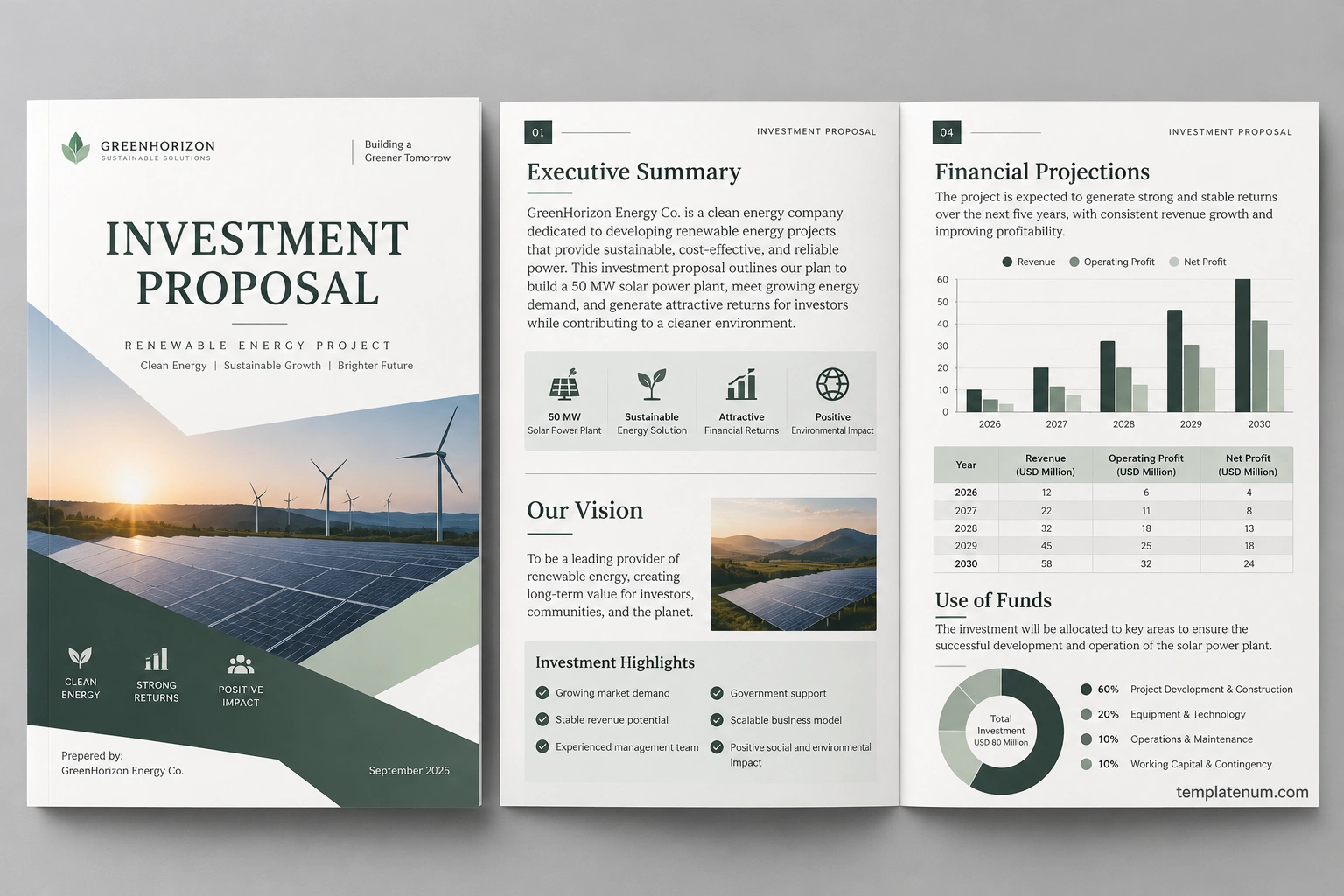
For example, a renewable energy investment proposal might describe a planned solar project, its target customers, development requirements, expected revenue, and estimated operating costs. The funding section would explain how capital supports construction, equipment, staffing, and ongoing operations.
These figures should be based on project-specific research and clearly stated assumptions. A sample proposal is useful for understanding document structure, but its financial figures and terms should never be treated as guaranteed outcomes or copied without verification.
Before using an investment proposal template, confirm that it can be edited easily and that its financial tables, charts, and headings suit your needs. Customize every section to reflect the actual business opportunity rather than leaving generic sample content in the final document.
Frequently Asked Questions About Investment Proposals
What is the main purpose of an investment proposal?
The main purpose of an investment proposal is to persuade potential investors to consider funding a business or project. It explains the opportunity, market potential, business strategy, financial projections, funding requirements, and expected investment structure.
What is the difference between an investment proposal and a business plan?
A business plan provides a broader explanation of how a company will operate and grow. An investment proposal focuses more directly on the funding opportunity, why the business is attractive to investors, how the capital will be used, and what financial outcomes may be possible.
How long should an investment proposal be?
The length depends on the complexity of the business and the investor’s requirements. A concise proposal may be sufficient for an initial discussion, while a larger project may require detailed financial models and supporting documents. Prioritize relevant information over unnecessary length.
What financial information should an investment proposal include?
Most proposals include revenue forecasts, operating expenses, cash flow projections, profitability estimates, funding requirements, and a break-even analysis when relevant. Established businesses may also include historical financial statements. All forecasts should clearly state their assumptions.
How do I calculate the amount of investment to request?
Estimate the capital required to achieve the next major business milestones. Include setup costs, operating expenses, planned growth investments, and an appropriate contingency allowance. Support the amount with a detailed use-of-funds breakdown and realistic cash flow projections.
Can I use an investment proposal template?
Yes. An investment proposal template can help organize the document and maintain a professional appearance. However, you should customize the content, financial information, funding terms, and supporting evidence to match the actual business opportunity.
Does an investment proposal guarantee funding?
No. An investment proposal helps communicate and evaluate an opportunity, but funding depends on factors such as business performance, investor objectives, risk, valuation, due diligence, and agreed terms. A strong proposal improves communication but cannot guarantee an investment.
What makes an investment proposal successful?
A successful investment proposal presents a credible opportunity, demonstrates market demand, provides realistic financial projections, explains the use of funds, and addresses important risks. It also makes the proposed investment structure and next steps clear.
Conclusion
An investment proposal is an important tool for presenting a business opportunity to potential investors. It combines a clear business case with market research, financial forecasts, a funding request, and a practical plan for achieving measurable goals.
To create a persuasive proposal, understand your audience, gather reliable evidence, explain your competitive advantage, and connect the requested capital to specific milestones. Keep financial projections realistic and address risks openly.
Whether you are launching a startup, expanding an established company, or developing a new project, a well-prepared investment proposal can help you communicate your vision professionally and begin meaningful discussions with potential investors.
Download: Investment Proposal Template Word
