A job safety analysis is an essential workplace safety tool that helps identify hazards before they cause injuries, illnesses, or accidents. By breaking a job into individual steps, employers and workers can examine potential risks and determine the safest way to complete each activity.
Also known as a Job Hazard Analysis (JHA), this process focuses on the relationship between workers, tasks, tools, equipment, and the work environment. It helps organizations recognize unsafe conditions, establish effective control measures, and develop safer work procedures.
Whether you work in construction, manufacturing, maintenance, transportation, or another industry, a job safety analysis can help make daily operations safer and more consistent. This guide explains how to conduct a JSA, what information to include, and how to use a job safety analysis template to organize the process.
What Is a Job Safety Analysis?
A job safety analysis (JSA) is a systematic process used to identify potential hazards associated with a specific job or task. It involves dividing the work into manageable steps, examining the hazards connected with each step, and selecting appropriate measures to eliminate or reduce the risks.
The main purpose of a job safety analysis is to prevent workplace injuries and illnesses by addressing hazards before work begins. Instead of waiting for an accident to happen, supervisors and employees evaluate how a task should be performed safely.
A JSA typically focuses on three main elements:
- Job steps: The individual activities required to complete a task.
- Potential hazards: Conditions or actions that could cause injury, illness, property damage, or other harm.
- Control measures: Procedures and protective actions used to eliminate or reduce identified risks.
A completed job safety analysis provides a written reference that workers and supervisors can use before and during the task. It should reflect actual working conditions rather than rely on assumptions or generic descriptions.
Why Is Job Safety Analysis Important?
Workplace hazards can exist in almost every industry. Employees may face risks from moving equipment, electrical systems, chemicals, elevated work areas, repetitive movements, or unexpected environmental conditions.
A job safety analysis helps organizations address these risks in a structured and proactive way.
1. Helps Prevent Workplace Accidents
Identifying hazards before starting a task gives workers an opportunity to take preventive action. Appropriate safeguards can reduce the likelihood of falls, equipment-related injuries, exposure incidents, and other workplace accidents.
2. Improves Employee Safety Awareness
When employees participate in a JSA, they become more aware of the hazards associated with their responsibilities. They can also learn which precautions, tools, and protective equipment are necessary for each activity.
3. Establishes Safer Work Procedures
A job safety analysis helps define how a task should be performed safely. The resulting instructions can be used to develop or improve standard operating procedures and employee training materials.
4. Encourages Employee Participation
Workers often understand the practical challenges of their daily tasks better than anyone else. Including them in the analysis helps identify hazards that may be overlooked during a management-only review.
5. Supports Workplace Safety Management
A documented JSA can support an organization’s broader occupational health and safety program. It provides evidence that specific job hazards have been considered and that appropriate preventive measures have been identified.
However, a JSA is only one part of an effective safety management system. It does not replace required inspections, training, emergency procedures, permits, or other applicable safety obligations.
When Should You Conduct a Job Safety Analysis?
A job safety analysis should be considered whenever a task involves significant hazards or when changes could affect how work is performed. It is particularly useful before employees begin unfamiliar or potentially dangerous activities.
Common situations that may require a JSA include:
- Before introducing a new job or work process.
- When new equipment, tools, or materials are introduced.
- When employees perform non-routine or high-risk tasks.
- After a workplace accident or near miss.
- When work conditions or the surrounding environment change.
- When an existing procedure appears ineffective or outdated.
- During periodic reviews of workplace safety procedures.
High-risk tasks should receive particular attention. Examples include working at heights, operating heavy machinery, performing electrical maintenance, handling hazardous chemicals, and entering confined spaces.
How to Conduct a Job Safety Analysis
Conducting a job safety analysis involves several steps. The process should be practical, collaborative, and based on the actual conditions in which the work will take place.
Step 1: Select the Job to Analyze
Start by choosing a specific job or activity. Avoid analyzing an entire department or a broad collection of unrelated tasks in one document.
Focus on work that presents significant risks, has a history of incidents, involves complicated procedures, or has recently changed. A clearly defined task makes the analysis easier to complete and review.
Step 2: Involve the Right People
Include employees who perform the task, supervisors, and safety professionals when appropriate. Their combined experience can help identify hazards and develop realistic control measures.
Ask workers about difficult activities, common mistakes, equipment problems, and conditions that could make the job unsafe.
Step 3: Break the Job into Individual Steps
Observe the task and divide it into a logical sequence of activities. Each step should describe an important action required to complete the job.
For example, a basic equipment maintenance task might include:
- Prepare the work area.
- Inspect the equipment.
- Isolate the energy sources.
- Perform the required maintenance.
- Inspect the equipment before returning it to service.
Keep each step specific enough to identify its hazards. However, avoid creating too many small steps that make the analysis difficult to follow.
Step 4: Identify Potential Hazards
Examine each job step and consider what could go wrong. Look at the worker’s actions, equipment, tools, materials, and surrounding environment.
Potential hazards may include:
- Physical hazards: Falling objects, excessive noise, heat, vibration, or slippery surfaces.
- Mechanical hazards: Moving machinery, rotating parts, sharp edges, and pinch points.
- Electrical hazards: Exposed wiring, damaged cables, electrical contact, or unexpected energization.
- Chemical hazards: Toxic substances, fumes, spills, and skin or eye exposure.
- Ergonomic hazards: Heavy lifting, repetitive movements, awkward postures, and excessive force.
- Environmental hazards: Poor lighting, extreme weather, limited ventilation, and restricted workspaces.
Consider both routine and unexpected conditions. A task that appears safe under normal circumstances may become dangerous when equipment fails or the work environment changes.
Step 5: Determine Appropriate Control Measures
After identifying hazards, decide how each risk should be eliminated or reduced. The control measures should be specific to the hazard and practical for the work environment.
Where applicable, use the hierarchy of controls to select protective measures. The preferred order is:
- Elimination: Remove the hazard completely.
- Substitution: Replace the hazardous material, process, or equipment with a safer alternative.
- Engineering controls: Isolate people from hazards using guards, barriers, ventilation, or other physical safeguards.
- Administrative controls: Reduce exposure through procedures, training, scheduling, warning signs, and restricted access.
- Personal protective equipment (PPE): Provide suitable protective equipment when additional protection is needed.
Personal protective equipment is important, but it should not automatically be treated as the only solution. Whenever reasonably possible, prioritize controls that remove hazards or protect workers at the source.
Step 6: Assign Responsibilities
Identify who is responsible for implementing each control measure. This may include the supervisor, equipment operator, maintenance team, safety officer, or another designated employee.
Clear responsibilities help ensure that safety measures are not overlooked before work begins.
Step 7: Review and Communicate the JSA
Review the completed analysis with the workers involved in the task. Make sure they understand the hazards, required precautions, equipment, and safe work procedures.
Update the document whenever work methods, equipment, materials, or environmental conditions change. A job safety analysis should remain relevant to the task being performed.
Job Safety Analysis Example
The following example demonstrates how a JSA can be organized for a basic equipment maintenance task. It is a general illustration, not a complete procedure for every type of machinery or worksite.
Job: Routine Equipment Maintenance
Work activity: Inspecting and performing maintenance on industrial equipment.
Required equipment: Approved maintenance tools, inspection equipment, and applicable PPE.
Potential hazards: Unexpected machine movement, electrical energy, sharp edges, and slips or trips.
Step 1: Prepare the work area
- Potential hazards: Cluttered floors, poor lighting, and unauthorized access.
- Control measures: Clear unnecessary materials, provide adequate lighting, and restrict access to the work area.
Step 2: Inspect the equipment
- Potential hazards: Sharp edges, damaged components, and unexpected movement.
- Control measures: Follow the approved inspection procedure and maintain a safe distance from moving parts.
Step 3: Isolate energy sources
- Potential hazards: Electrical shock or unexpected equipment startup.
- Control measures: Follow the site’s energy isolation and lockout/tagout procedures. Verify that the equipment is in a safe condition before maintenance begins.
Step 4: Perform maintenance
- Potential hazards: Tool injuries, contact with hazardous substances, and awkward working positions.
- Control measures: Use suitable tools, follow manufacturer instructions, wear required PPE, and apply appropriate handling procedures.
Step 5: Complete the inspection and restore equipment
- Potential hazards: Missing guards, tools left inside the machine, or unsafe restart conditions.
- Control measures: Check the work area, reinstall required guards, account for tools, and follow the approved equipment restart procedure.
The example should be reviewed and adapted by qualified personnel before being used at an actual worksite. Specific machinery may require additional safeguards, permits, isolation procedures, and manufacturer instructions.
What Should a Job Safety Analysis Form Include?
A job safety analysis form provides a consistent structure for documenting the assessment. Although layouts may vary, a practical JSA worksheet generally includes the following information.
General Job Information
Record the job title, work location, department, JSA reference number, assessment date, and name of the person preparing the analysis.
Tools, Equipment, and PPE
List the tools and equipment required to complete the task. Identify the personal protective equipment workers must use based on the hazards and applicable safety requirements.
Job Steps and Potential Hazards
Describe each activity in sequence and identify the hazards associated with it. Use clear descriptions that workers can easily understand.
Recommended Safe Work Measures
Document the control measures needed to eliminate or reduce each identified risk. Avoid vague instructions such as “be careful.” Instead, describe the actual action workers must take.
Risk Rating and Approval
If the organization’s risk assessment procedure requires it, include a risk rating based on the likelihood and potential severity of harm. Provide spaces for the preparer’s, reviewer’s, and approver’s names and dates.
Printable Job Safety Analysis Template
A printable job safety analysis template makes it easier to record job steps, identify hazards, and document preventive measures. It also helps organizations maintain a consistent format across different tasks and departments.
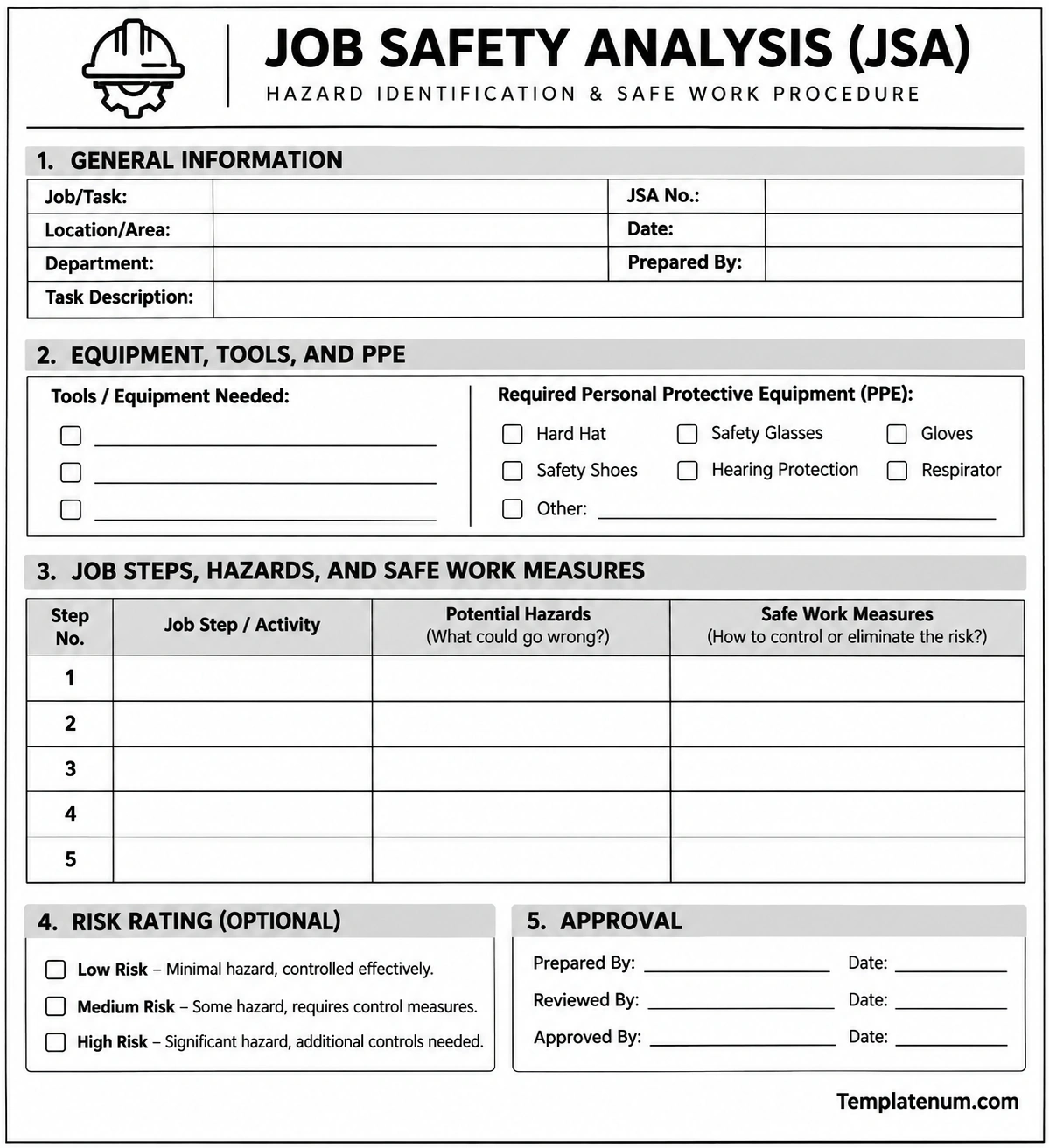
A useful JSA form should include general job information, required tools and PPE, a table for job steps and potential hazards, recommended safe work measures, and approval details. Additional sections can be included for risk ratings or site-specific requirements.
The sample below features a clean black-and-white design with clearly separated sections. It provides a practical layout for documenting a job hazard analysis and reviewing the safety measures required before work begins.
Common Job Safety Analysis Mistakes to Avoid
A JSA is only effective when it accurately reflects the work being performed. Avoid these common mistakes when preparing or reviewing the document.
- Using vague job steps: Describe each activity clearly so workers understand what is being assessed.
- Overlooking less obvious hazards: Consider environmental conditions, ergonomics, human factors, and unexpected equipment problems.
- Relying only on PPE: Evaluate whether hazards can be eliminated, substituted, or controlled through engineering measures first.
- Ignoring employee feedback: Involve workers who perform the task because they may recognize practical risks that others miss.
- Copying an outdated JSA: Review the document whenever work methods, tools, materials, or conditions change.
- Failing to communicate the results: Make sure employees understand the identified hazards and required precautions before starting work.
- Not checking whether controls work: Monitor the task and revise the analysis when existing measures are ineffective.
Frequently Asked Questions About Job Safety Analysis
What is the main purpose of a job safety analysis?
The main purpose of a job safety analysis is to identify hazards associated with specific job activities and determine appropriate measures to eliminate or reduce risks. This proactive approach helps prevent workplace injuries and illnesses.
What is the difference between JSA and JHA?
JSA stands for Job Safety Analysis, while JHA stands for Job Hazard Analysis. Both terms generally describe a process that breaks a job into steps, identifies potential hazards, and establishes appropriate controls. Terminology and documentation practices may vary between organizations.
Who should conduct a job safety analysis?
A JSA is commonly prepared by a supervisor, safety professional, or another qualified person with knowledge of the task. Employees who perform the job should also participate because their practical experience can help identify hazards and suitable controls.
How often should a job safety analysis be reviewed?
A JSA should be reviewed whenever a significant change affects the task, equipment, materials, work environment, or safety procedures. It should also be reassessed after an incident or near miss and periodically according to the organization’s safety management process.
What are the five steps of a job safety analysis?
A simplified five-step process includes selecting the job, breaking it into steps, identifying potential hazards, determining control measures, and reviewing and communicating the completed analysis. Some organizations use additional steps for assigning responsibilities and monitoring controls.
Is a job safety analysis required by law?
Requirements vary by country, industry, activity, and applicable safety regulations. Some standards or workplace procedures require specific hazard assessments for certain tasks. Organizations should check the rules that apply to their location and operations.
What is included in a JSA form?
A typical JSA form includes job information, work location, tools and equipment, required PPE, job steps, potential hazards, recommended control measures, and approval details. Some forms also include risk ratings and review dates.
Can a job safety analysis prevent all workplace accidents?
No. A JSA can help reduce risks, but it cannot guarantee that every accident will be prevented. Its effectiveness depends on accurate hazard identification, appropriate controls, employee training, supervision, and regular reviews of actual working conditions.
Conclusion
A job safety analysis is a valuable tool for identifying workplace hazards and establishing safer ways to perform tasks. By breaking work into individual steps, evaluating potential risks, and selecting appropriate control measures, organizations can take preventive action before incidents occur.
Whether you are preparing a JSA for construction, manufacturing, maintenance, or another industry, involve the workers who perform the task and make sure the assessment reflects real working conditions. Use a clear job safety analysis form, communicate the findings, and review the document whenever conditions change.
A consistent and practical JSA process can strengthen workplace safety awareness, improve work procedures, and support a safer working environment for everyone.
Download: Job Safety Analysis Template
