A KWL chart is a simple but effective graphic organizer that helps students organize their thoughts, ask meaningful questions, and reflect on what they learn. By dividing a worksheet into three columns—Know, Want to Know, and Learned—students can connect their existing knowledge with new information throughout a lesson or learning activity.
Whether you are a teacher introducing a new classroom topic, a parent supporting learning at home, or a student preparing for a research project, a KWL chart can make the learning process more organized and engaging. It encourages students to think about what they already understand, identify what they want to discover, and review what they have learned.
In this guide, you will learn how a KWL chart works, how to use each section, and how to make the most of this versatile educational worksheet. You can also use the free printable template to get started with your next lesson or study activity.
What Is a KWL Chart?
A KWL chart is a three-column graphic organizer used to guide students before, during, and after a learning experience. The letters K, W, and L represent three stages of learning: what students Know, what they Want to Know, and what they have Learned.
This educational worksheet provides a structured way to activate prior knowledge, establish learning goals, and reflect on new information. Rather than simply listening to a lesson or reading a passage, students actively participate by writing down their thoughts and questions.
Teachers can use a KWL chart with almost any subject, including science, history, mathematics, reading, geography, and social studies. Its straightforward format makes it suitable for elementary students, middle school learners, high school students, and even adult education.
What Do the Three Columns of a KWL Chart Mean?
Each section of a KWL chart has a specific purpose. Students typically complete the first two columns before or at the beginning of a lesson and fill in the final column after exploring the topic.
1. K – What I Know
The first column focuses on what students already know about a particular subject. Before beginning a lesson, students write down their existing knowledge, personal experiences, facts, or ideas related to the topic.
This stage activates prior knowledge and helps students connect new information with what they have previously learned.
For example, if the lesson is about butterflies, students might write:
- Butterflies have wings.
- Butterflies start as caterpillars.
- Some butterflies have colorful patterns.
- Butterflies visit flowers.
Students do not need to know everything about the subject. The purpose is to record their current understanding, including ideas that may need further investigation.
2. W – What I Want to Know
The second column encourages students to think about what they want to discover. They write questions about the topic, identify areas they do not understand, and set personal learning goals.
This section helps turn curiosity into specific questions that students can explore during the lesson.
For example, students studying butterflies might ask:
- How long does a butterfly live?
- How does a caterpillar become a butterfly?
- Why do butterflies have different colors?
- What do butterflies eat?
These questions give students a purpose for learning and help teachers understand which topics interest their class.
3. L – What I Learned
The final column is completed after students have finished the lesson, reading assignment, research activity, or learning unit. They write down the new facts, explanations, and ideas they have discovered.
This stage encourages reflection and helps students compare their initial understanding with their new knowledge.
For example, after studying butterflies, students might write:
- Butterflies go through four stages of development.
- The four stages are egg, larva, pupa, and adult.
- Butterflies use their proboscis to drink nectar.
- Many butterflies help pollinate flowers.
Students can also review their original questions and identify which ones have been answered. Any unanswered questions can become ideas for further research.
Free Printable KWL Chart Template
Using a printable KWL chart template makes it easy for students to organize their thinking without having to draw the three-column layout themselves. The worksheet provides dedicated spaces for recording prior knowledge, learning questions, and new discoveries.
This simple KWL chart printable features a topic field and three clearly labeled sections. Its clean design provides plenty of writing space, making it suitable for individual assignments, group discussions, and classroom activities.
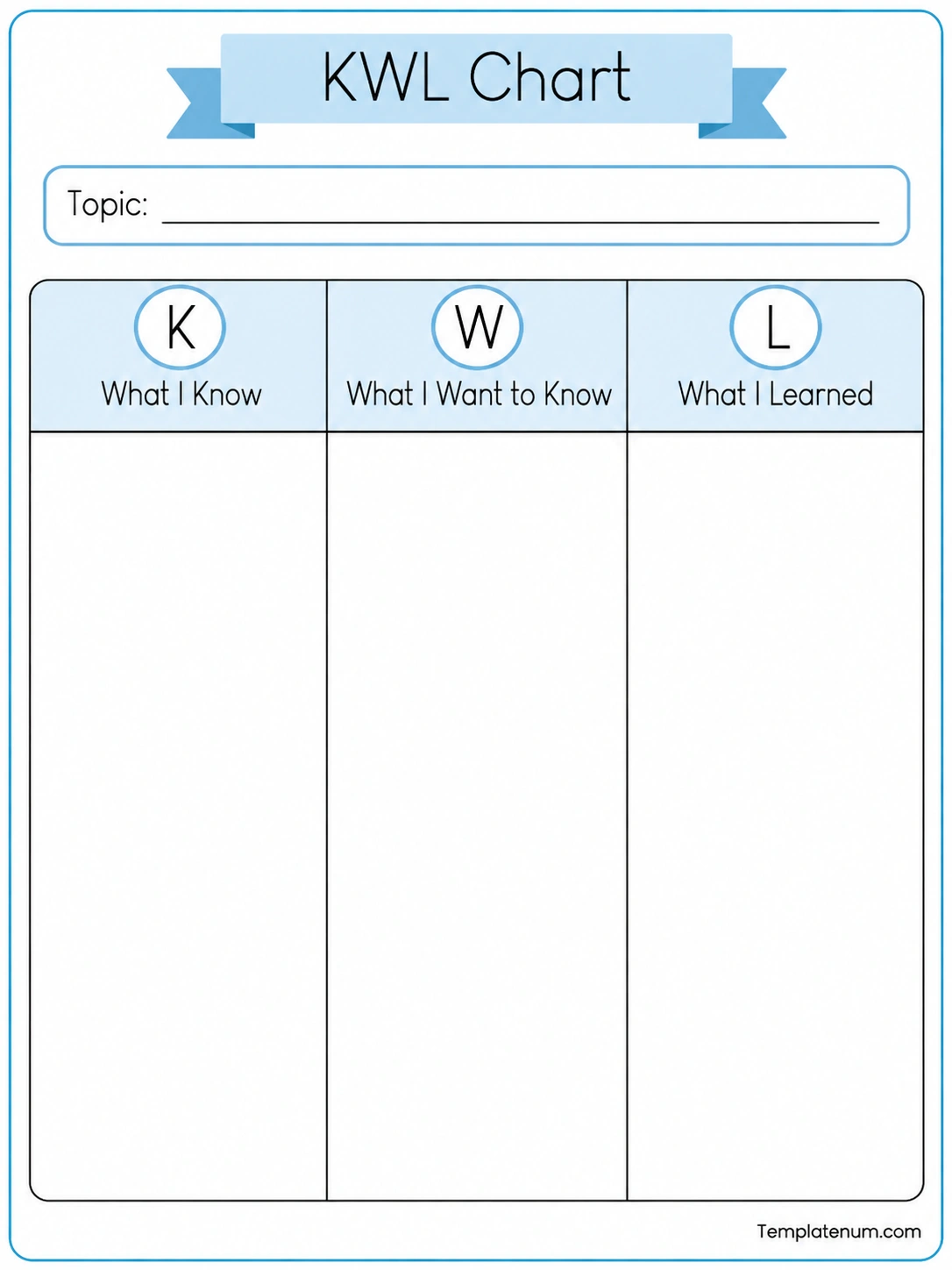
To use the worksheet, simply print a copy, write the lesson topic in the space provided, and complete each column as you progress through the learning activity. You can use a separate worksheet for each subject or learning unit.
How to Use a KWL Chart in the Classroom
A KWL chart can be incorporated into different stages of a lesson. Teachers can use it as an individual activity, a group discussion tool, or a whole-class learning organizer.
Step 1: Introduce the Topic
Start by presenting the subject students will explore. This could be a science topic, a historical event, a reading passage, or a new chapter in a textbook.
Give students a few minutes to think about the subject and discuss what they already know. Ask simple questions to encourage participation.
Step 2: Complete the Know Column
Ask students to write their existing knowledge in the first column. Encourage them to include facts, personal experiences, and ideas, even if they are unsure about some details.
Teachers can review these responses to identify misconceptions and understand students’ starting points.
Step 3: Complete the Want to Know Column
Next, encourage students to develop questions about the subject. They should think about what they are curious about and what they hope to understand by the end of the lesson.
For younger learners, teachers can provide question starters such as who, what, when, where, why, and how.
Step 4: Explore the Topic
Students can now begin the main learning activity. They may read a textbook, watch an educational video, participate in a classroom experiment, conduct research, or listen to a lesson.
Encourage them to refer to their questions in the second column while exploring the subject.
Step 5: Complete the Learned Column
After the lesson, ask students to record the most important things they have learned. They should use their own words rather than simply copying information from a textbook.
Finally, review the entire chart and discuss how their understanding has changed. This reflection helps students recognize their progress and identify topics that may need additional attention.
Benefits of Using a KWL Chart
A KWL chart offers several benefits for both students and teachers. Its simple structure supports active learning while providing a useful overview of student understanding.
- Activates prior knowledge: Students recall information and experiences before exploring a new topic.
- Encourages curiosity: The question section motivates students to investigate subjects more deeply.
- Improves engagement: Students become active participants rather than passive listeners.
- Organizes information: The three-column format makes ideas and learning progress easier to follow.
- Promotes reflection: Students review what they have learned and recognize changes in their understanding.
- Supports assessment: Teachers can use student responses to identify knowledge gaps and adjust instruction.
- Develops critical thinking: Students practice asking questions, evaluating information, and connecting ideas.
Subjects and Activities That Work Well with KWL Charts
One of the best features of a KWL chart is its flexibility. It can be adapted to almost any subject or learning experience.
Science Lessons
Students can use a KWL worksheet to explore animals, plants, weather, the human body, ecosystems, or the solar system. They can record what they already know and develop questions before conducting experiments or reading scientific materials.
Reading and Language Arts
Before reading a book or passage, students can write down what they know about its subject. They can then list questions they hope the reading will answer and summarize their discoveries afterward.
History and Social Studies
A KWL organizer can help students explore historical events, famous people, cultures, countries, and important periods in history. It encourages them to connect previous knowledge with new historical information.
Mathematics
Teachers can use a KWL chart when introducing mathematical concepts such as fractions, geometry, multiplication, or measurement. Students can identify familiar concepts, ask questions about unfamiliar problems, and record new strategies they have learned.
Research Projects
Students can use a KWL chart to plan research assignments. The first two columns help establish a starting point and research questions, while the final column provides a place to summarize important findings.
Tips for Making KWL Charts More Effective
Although the format is simple, a few teaching strategies can make a KWL chart more useful and meaningful.
- Choose a focused topic: A specific subject makes it easier for students to develop relevant questions.
- Encourage independent thinking: Allow students to write their own ideas before discussing answers as a group.
- Welcome different questions: Do not limit students to questions that have obvious answers.
- Revisit the chart: Refer to the worksheet throughout the lesson rather than completing it all at once.
- Discuss unanswered questions: Use them as opportunities for additional reading or research.
- Use clear instructions: Explain the purpose of each column so students understand what information belongs in each section.
Frequently Asked Questions About KWL Charts
What does KWL stand for in education?
KWL stands for Know, Want to Know, and Learned. These three sections help students identify prior knowledge, establish learning questions, and reflect on what they discover during a lesson.
What is the purpose of a KWL chart?
The purpose of a KWL chart is to help students organize their thinking before, during, and after learning. It activates prior knowledge, encourages curiosity, supports active learning, and provides a simple way to reflect on new information.
When should students complete a KWL chart?
Students typically complete the Know and Want to Know columns before or at the beginning of a lesson. They fill in the Learned column after completing the lesson, reading assignment, or research activity.
Who can use a KWL chart?
KWL charts can be used by elementary, middle school, and high school students, as well as adult learners. Teachers, tutors, and parents can also use them to guide discussions and assess understanding.
Can a KWL chart be used for any subject?
Yes. A KWL chart is flexible enough for science, mathematics, reading, history, geography, social studies, and many other subjects. It can also support independent research and project-based learning.
What is the difference between a KWL chart and a regular graphic organizer?
A KWL chart specifically focuses on the learning process. It connects what students already know with what they want to discover and what they eventually learn. Other graphic organizers may focus on different purposes, such as comparing information, organizing sequences, or identifying relationships.
How do teachers assess students using a KWL chart?
Teachers can review all three columns to understand students’ starting knowledge, learning goals, and final understanding. Comparing the first and third columns can reveal misconceptions, progress, and areas that may require additional instruction.
Conclusion
A KWL chart is a practical educational tool that helps students become more active and organized learners. By using the Know, Want to Know, and Learned columns, students can connect existing knowledge with new discoveries while developing meaningful questions along the way.
For teachers, this graphic organizer offers a straightforward way to understand student thinking, guide classroom discussions, and evaluate learning progress. For students, it provides a clear structure for setting learning goals and reflecting on new information.
Whether you are preparing a classroom lesson, planning a research project, or supporting learning at home, a printable KWL chart template is an easy resource to incorporate into your activities. Print a copy, choose a topic, and start organizing your learning today.
Download: KWL Chart Template
