An hourly schedule is a simple way to organize your day by assigning specific tasks and activities to designated times. Instead of keeping a general to-do list, an hourly schedule gives each important activity a place on your calendar. This makes it easier to see what needs to be done, when it should be completed, and how much time is available throughout the day.
Creating an hourly schedule can provide structure, improve time management, and help you stay focused on your priorities. It can be useful for students, professionals, parents, business owners, remote workers, and anyone who wants a clearer plan for the day.
A good schedule should provide enough structure to keep you organized without making your entire day feel rigid. By leaving reasonable space for breaks, unexpected tasks, and changes in priorities, you can create a daily plan that is both productive and practical.
What Is an Hourly Schedule?
An hourly schedule is a daily planning system that divides the day into specific time periods. Each time block is assigned to a task, activity, appointment, break, or personal responsibility.
For example, instead of writing “work on project” on a general to-do list, you could schedule it from 9:00 AM to 11:00 AM. You might then reserve 11:00 AM to 11:30 AM for email and 11:30 AM to 12:30 PM for another priority.
This approach makes your available time visible. It can also help you estimate whether your workload is realistic before the day begins.
Why Use an Hourly Schedule?
Planning your day by the hour can make it easier to manage competing responsibilities. Rather than deciding what to do next every time you finish a task, you have a basic plan to follow.
An hourly schedule can help you:
- Organize tasks and appointments
- Improve time management
- Stay focused on important work
- Reduce distractions
- Set realistic time limits for tasks
- Remember appointments and deadlines
- Make time for breaks and personal activities
- Balance work, school, and home responsibilities
- See how your time is being used
The goal is not to fill every minute of the day. Instead, the goal is to create enough structure to help you use your available time intentionally.
How to Create an Hourly Schedule
Creating an effective daily schedule does not require a complicated planning system. A simple worksheet with time slots can be enough to get started.
1. Start With Fixed Commitments
Begin by writing down activities that have a fixed start or end time. These might include work hours, classes, appointments, meetings, school drop-off, or other commitments.
Adding fixed activities first gives you a realistic picture of how much flexible time remains.
2. List Your Priorities
Next, identify the tasks that are most important for the day. Try to distinguish between tasks that must be completed today and tasks that can be postponed if necessary.
Choosing a few daily priorities can prevent your schedule from becoming overloaded.
3. Estimate How Long Each Task Will Take
Give each activity a realistic amount of time. If you are unsure, estimate slightly more time rather than assuming everything will go perfectly.
For example, if you think a report will take 90 minutes, avoid scheduling another important task immediately afterward unless you have enough flexibility to handle an unexpected delay.
4. Assign Tasks to Time Blocks
Place your priorities into appropriate time slots. Consider your energy level, deadlines, appointments, and the type of work involved.
More demanding tasks may be easier to complete during the part of the day when you normally have the most energy and concentration.
5. Add Breaks
Breaks are an important part of an effective hourly schedule. Continuous work without planned pauses can make it harder to maintain concentration.
Include short breaks throughout the day as well as a reasonable meal period.
6. Leave Some Flexibility
Avoid scheduling every minute. Unexpected phone calls, delays, urgent tasks, and changes in plans can happen.
Leaving some open time gives you room to adjust without completely disrupting the rest of your schedule.
Hourly Schedule Example
A simple daily schedule might look like this:
- 6:00 AM: Wake up and morning routine
- 7:00 AM: Breakfast and preparation
- 8:00 AM: Review priorities and begin work
- 9:00 AM: Focused work session
- 10:00 AM: Continue priority project
- 11:00 AM: Email and administrative tasks
- 12:00 PM: Lunch and break
- 1:00 PM: Meetings or collaborative work
- 2:00 PM: Focused project work
- 3:00 PM: Short break and routine tasks
- 4:00 PM: Complete remaining priorities
- 5:00 PM: Review work and plan tomorrow
- 6:00 PM: Personal or family time
- 7:00 PM: Dinner and relaxation
- 8:00 PM: Personal projects or leisure
- 9:00 PM: Prepare for the next day
- 10:00 PM: Wind down for the evening
This is only an example. The best hourly schedule depends on your responsibilities, preferred working hours, energy levels, and personal goals.
Hourly Schedule vs. To-Do List
An hourly schedule and a to-do list can work together, but they serve different purposes.
A to-do list tells you what needs to be done. An hourly schedule helps you decide when you will do it.
For example, a to-do list might contain:
- Write a report
- Answer emails
- Exercise
- Buy groceries
- Study for an exam
An hourly schedule takes those activities and places them into specific periods. This can make a long list of tasks feel more manageable because each task has a planned place in the day.
How to Prioritize Tasks in an Hourly Schedule
Not every task deserves the same amount of attention. Prioritizing your work before filling in the schedule can help you protect time for the activities that matter most.
Identify Must-Do Tasks
Start with deadlines, appointments, and responsibilities that cannot easily be moved.
Schedule Important Work Early
If an important project requires concentration, consider scheduling it during a period when you are usually most alert.
Group Similar Tasks
Similar activities can sometimes be grouped together. For example, you could dedicate one time block to emails, phone calls, or administrative work rather than switching between these activities throughout the day.
Separate Urgent and Important Tasks
A task can be urgent without being the most important activity of the day. Review your priorities carefully so urgent interruptions do not automatically consume all of your available time.
Benefits of Using an Hourly Schedule Template
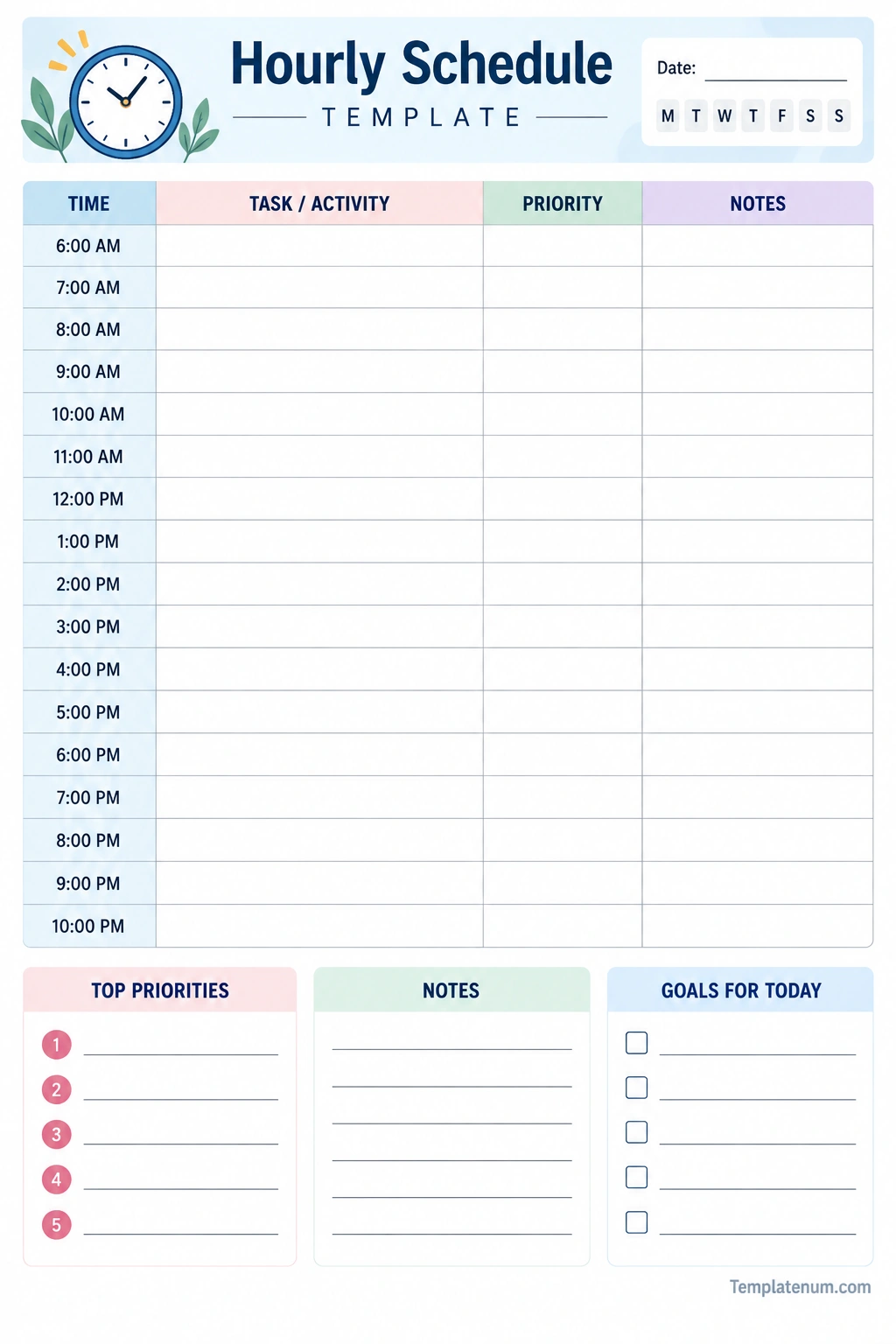
An hourly schedule template provides a ready-made structure for planning the day. Instead of drawing a new timetable every morning, you can simply fill in the appropriate time slots.
A printable template can be particularly useful for people who prefer writing their plans by hand.
Useful sections may include:
- Time slots
- Task or activity
- Priority level
- Notes
- Daily goals
- Important appointments
- End-of-day review
Keeping the layout simple makes it easier to scan quickly throughout the day.
Hourly Schedule for Work
An hourly work schedule can help employees, freelancers, entrepreneurs, and remote workers organize professional responsibilities.
You can use time blocks for:
- Deep work
- Meetings
- Administrative tasks
- Project planning
- Client communication
- Research
- Breaks
- End-of-day planning
When possible, protect uninterrupted blocks for work that requires concentration. Frequent task switching can make it harder to maintain focus.
Hourly Schedule for Students
Students can use an hourly schedule to balance classes, homework, studying, activities, meals, and rest.
Plan Around Classes
Start by entering your class schedule. Then use the remaining time for study sessions, assignments, activities, and personal responsibilities.
Break Large Assignments Into Blocks
Instead of scheduling “finish project” as one large task, divide the work into smaller activities such as research, outlining, writing, editing, and final review.
Schedule Study Breaks
Regular breaks can make a long study period easier to manage. Use your schedule to create a sustainable study routine rather than attempting to study continuously for many hours.
Hourly Schedule for Home and Personal Life
An hourly schedule does not have to be limited to work or school. It can also organize household responsibilities and personal activities.
Possible activities include:
- Meal preparation
- Household chores
- Exercise
- Shopping
- Family activities
- Appointments
- Personal projects
- Relaxation
- Bedtime preparation
Including personal activities in your schedule can help prevent work from taking over the entire day.
How to Make an Hourly Schedule Flexible
A common mistake is creating a schedule that is so strict that one unexpected event causes the entire plan to collapse. Flexibility is an important part of practical time management.
Use Buffer Time
Leave small gaps between demanding activities when possible. These gaps can absorb minor delays or provide time to reset before the next task.
Have a Backup Plan
If an important task cannot be completed at its scheduled time, decide where it can be moved rather than abandoning it completely.
Review Your Schedule During the Day
Your schedule is a planning tool, not a permanent contract. If priorities change, adjust the remaining time blocks accordingly.
Common Hourly Scheduling Mistakes
An hourly schedule is most useful when it reflects reality. Avoid creating a plan that looks productive on paper but is difficult to follow in practice.
- Scheduling too many tasks
- Ignoring travel or transition time
- Leaving out breaks
- Underestimating how long tasks take
- Filling every minute of the day
- Failing to account for interruptions
- Prioritizing easy tasks over important tasks
- Never reviewing the schedule
Tips for Following Your Hourly Schedule
Creating a schedule is only the first step. The next step is using it consistently enough to learn what works.
- Prepare your schedule the night before or at the beginning of the day.
- Choose a small number of important priorities.
- Start tasks at their planned times whenever practical.
- Keep distractions away during focused work periods.
- Use breaks to reset rather than fill them with additional work.
- Adjust the schedule when circumstances change.
- Review unfinished tasks at the end of the day.
- Use what you learn to improve tomorrow’s schedule.
How to Improve Your Hourly Schedule Over Time
Your first schedule does not need to be perfect. In fact, reviewing your actual day can provide useful information for creating better schedules in the future.
At the end of the day, ask yourself:
- Which tasks took longer than expected?
- Which activities were completed easily?
- When was my concentration strongest?
- Where did unexpected interruptions occur?
- Did I schedule enough breaks?
- Which tasks should move to another day?
Use these observations to make small adjustments. Over time, your schedule can become more realistic and better suited to your working habits.
Frequently Asked Questions About Hourly Schedules
What is an hourly schedule?
An hourly schedule is a daily planning tool that divides the day into specific time periods and assigns tasks, activities, appointments, breaks, or goals to those periods.
What are the benefits of an hourly schedule?
An hourly schedule can improve organization, support time management, make priorities more visible, reduce unnecessary task switching, and provide structure for work, school, and personal activities.
How do I make a good hourly schedule?
Start with fixed commitments, identify your most important tasks, estimate how long activities will take, assign them to appropriate time blocks, include breaks, and leave some flexible time for unexpected events.
Should an hourly schedule include breaks?
Yes. Including breaks can make a daily schedule more realistic and provide time to rest between demanding activities. Breaks can also help prevent the schedule from becoming unnecessarily rigid.
Can I use an hourly schedule for work and school?
Yes. An hourly schedule can be adapted for work, school, household responsibilities, appointments, exercise, personal projects, and other daily activities.
Is it better to schedule every hour of the day?
Not necessarily. Leaving some open time for transitions, unexpected events, and rest can make an hourly schedule easier to follow and adjust.
Conclusion
An hourly schedule provides a practical structure for organizing tasks, appointments, priorities, breaks, and personal activities throughout the day. By assigning activities to specific time blocks, you can make your available time easier to understand and create a clearer path toward your daily goals.
The most effective schedule is not necessarily the busiest one. A useful plan should be realistic, flexible, and designed around your actual responsibilities and energy levels. Include important priorities, allow enough time for each activity, and leave room for unexpected changes.
Whether you use a printable hourly schedule template for work, school, household tasks, or personal goals, reviewing and adjusting your plan regularly can help you build a daily routine that is organized, productive, and sustainable.
Download: Hourly Schedule Template
