A lead paint disclosure form for tenants is an important document that landlords must provide before renting most residential properties built before 1978. It informs prospective tenants about known lead-based paint and potential lead hazards in the rental property. This disclosure helps tenants make informed decisions about their living environment while helping landlords meet federal requirements.
If you are renting an older house or apartment, understanding this document is essential. It explains what information landlords must disclose, which records tenants should receive, and how the acknowledgment process works. In this guide, you will learn how to use a lead paint disclosure form, what information it should contain, and how to prepare one for a residential lease.
What Is a Lead Paint Disclosure Form for Tenants?
A lead paint disclosure form for tenants is a written document used to communicate information about known lead-based paint and lead-based paint hazards in residential rental properties. It is generally required for housing built before 1978 under the federal Residential Lead-Based Paint Hazard Reduction Act, also known as Title X.
The document allows landlords to disclose whether they know about lead-based paint or related hazards in the property. It also confirms that tenants have received available inspection records, reports, and the required EPA information pamphlet.
Both landlords and tenants should review the disclosure carefully before completing the lease agreement. The signed document serves as written evidence that the required information was provided and acknowledged.
Why Is a Lead Paint Disclosure Required?
Lead-based paint was commonly used in residential buildings before the federal government banned its use in housing in 1978. Although older paint may remain in existing properties, deteriorating paint can create hazardous dust and paint chips.
Exposure to lead can cause serious health problems, particularly for young children and pregnant women. Children exposed to lead may experience developmental delays, learning difficulties, and other neurological problems.
Federal disclosure requirements were established to help protect renters and homebuyers by ensuring they receive important information before entering into a housing agreement.
The disclosure requirement does not automatically mean that a property contains lead-based paint. Instead, it requires landlords to communicate known information and provide available documentation.
What Information Should a Lead Paint Disclosure Form Include?
A complete lead paint disclosure form should contain several important sections. These sections document the landlord’s disclosures and confirm that the tenant received the required information.
1. Property Information
The first section identifies the rental property covered by the disclosure. It should include basic details such as:
- Property address.
- City, state, and ZIP code.
- Landlord or property owner’s name.
- Tenant’s name.
- Rental unit or apartment number, if applicable.
Accurate property information helps ensure that the disclosure is associated with the correct rental agreement.
2. Lead-Based Paint Disclosure
This section requires the landlord to disclose whether they know about the presence of lead-based paint or lead-based paint hazards in the property.
The landlord should indicate one of the following:
- Known lead-based paint and/or lead-based paint hazards are present.
- The landlord has no knowledge of lead-based paint and/or lead-based paint hazards in the property.
If lead-based paint or hazards are known to exist, the landlord should provide additional available information, including their location and the condition of affected painted surfaces.
3. Records and Inspection Reports
Landlords must provide tenants with available records and reports concerning lead-based paint and lead-based paint hazards.
These documents may include:
- Lead-based paint inspection reports.
- Lead risk assessment reports.
- Previous lead hazard evaluation documents.
- Records concerning lead hazards in common areas or other units, when applicable.
If no records or reports are available, the landlord should clearly indicate that no such documents exist.
4. Tenant Acknowledgment
The acknowledgment section confirms that the tenant has received the required lead-related information. It should document receipt of the landlord’s disclosures, available records and reports, and the EPA information pamphlet titled Protect Your Family From Lead in Your Home.
The tenant’s signature confirms receipt of the information. It does not necessarily mean that the tenant agrees that the property is free from lead hazards.
5. Signatures and Dates
The final section provides space for the landlord, tenant, and any applicable real estate agent to sign and date the disclosure.
These signatures certify that the information provided is accurate to the best of each party’s knowledge and document completion of the disclosure process.
Who Needs to Complete a Lead Paint Disclosure Form?
The federal lead-based paint disclosure rule generally applies to landlords renting residential properties built before 1978. It also involves other parties who participate in the rental transaction.
Landlords and Property Owners
Landlords are responsible for disclosing known lead-based paint information, providing available records and reports, and giving tenants the required EPA pamphlet. They must also ensure that the required warning statement and signed acknowledgments are included in the lease documentation.
Tenants
Tenants should carefully review the disclosure before signing the lease. They should check the information provided, request available reports if necessary, and keep a copy of the completed document for their records.
Real Estate Agents and Property Managers
Agents and property managers involved in renting covered properties also have responsibilities under federal disclosure regulations. They must help ensure that the landlord understands and fulfills the applicable requirements.
When Is a Lead Paint Disclosure Form Required?
The disclosure must be completed before the tenant becomes obligated under the lease agreement. In practice, landlords should provide the disclosure and required information before the lease is signed.
The federal rule generally covers residential properties built before 1978, including many single-family homes and apartment buildings.
However, certain properties and rental arrangements are exempt from the federal disclosure rule, including:
- Housing constructed after 1977.
- Zero-bedroom dwellings, such as certain studio apartments and dormitories, unless a child under six years of age resides or is expected to reside there.
- Leases lasting 100 days or less when no lease renewal or extension can occur.
- Housing specifically designated for elderly persons or persons with disabilities, unless a child under six resides or is expected to reside there.
- Housing certified as lead-based-paint-free by an appropriately certified inspector.
These exemptions have specific conditions. Landlords should review the applicable federal and state requirements before deciding that a property is exempt.
How to Complete a Lead Paint Disclosure Form
Completing a lead paint disclosure form is straightforward when landlords follow the required steps.
Step 1: Identify the Rental Property
Enter the complete property address and identify the landlord and prospective tenant. Make sure the information matches the residential lease agreement.
Step 2: Disclose Known Lead Information
Review available property records and indicate whether known lead-based paint or lead-based paint hazards are present. If hazards are known, provide the relevant details rather than leaving the disclosure incomplete.
Step 3: Provide Available Records
Attach or provide copies of available inspection reports, risk assessments, and other relevant lead-related documentation. Clearly state when no records or reports are available.
Step 4: Provide the EPA Information Pamphlet
Give the tenant a copy of the official EPA pamphlet titled Protect Your Family From Lead in Your Home. This pamphlet explains potential exposure risks and practical ways to protect household members.
Step 5: Obtain Required Signatures
Ask the landlord, tenant, and any applicable agent to complete the required acknowledgment and signature sections. Each party should receive a copy of the completed disclosure.
Free Lead Paint Disclosure Form for Tenants Template
Using a printable lead paint disclosure form can make the rental documentation process more organized. A simple template provides designated spaces for property information, landlord disclosures, available records, tenant acknowledgment, and signatures.
The following template preview illustrates a clean and professional layout that can be used as a starting point when preparing rental disclosure documents.
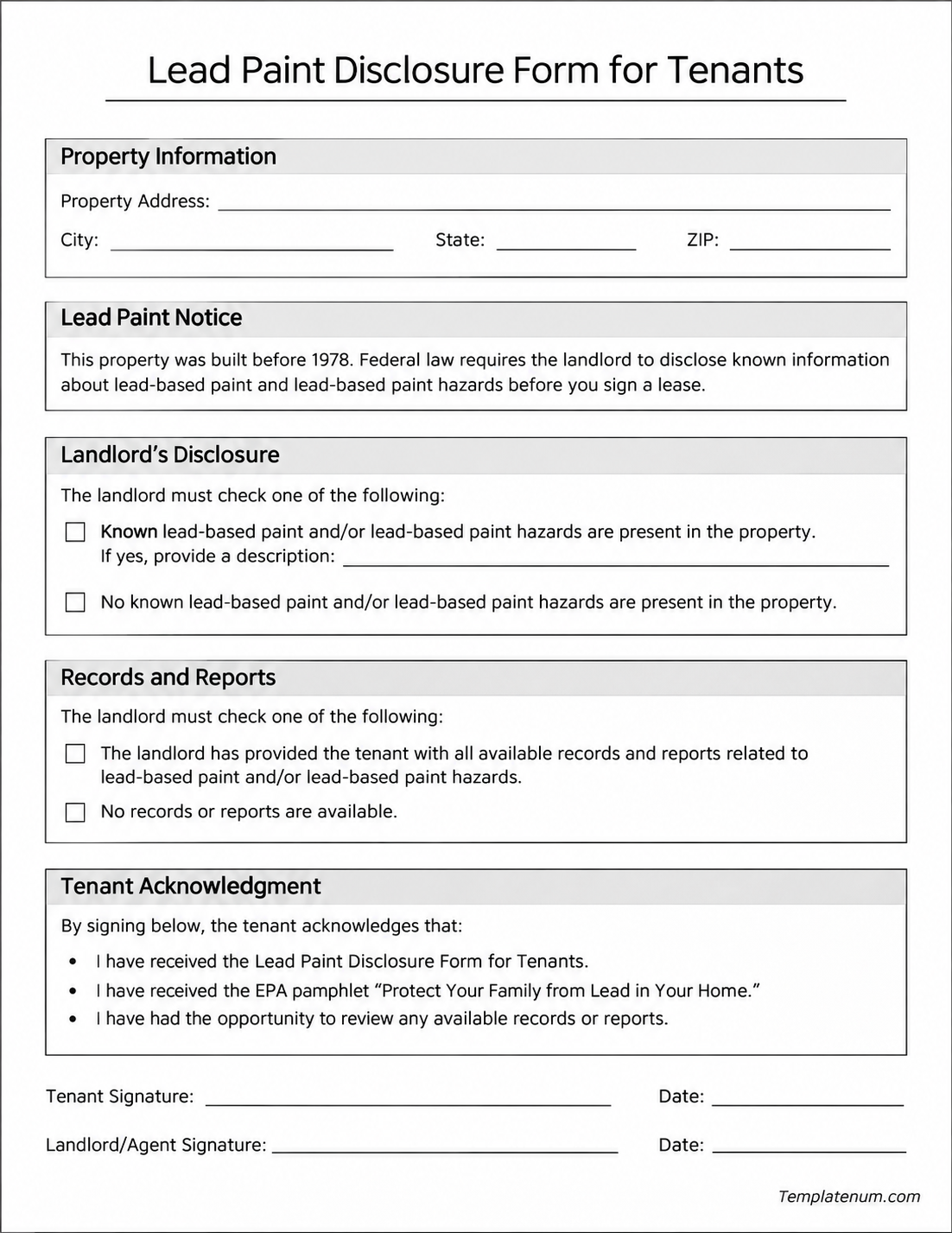
Before using a template, make sure it contains all applicable federal disclosure language and acknowledgment requirements. The preview is an illustrative document, not a substitute for the complete legally required disclosure attachment.
Important Tips for Landlords and Tenants
Both parties should take a few precautions to ensure that the lead paint disclosure process is completed properly.
Tips for Landlords
- Determine whether the property was built before 1978.
- Review existing inspection reports and lead-related records.
- Disclose all known lead-based paint hazards accurately.
- Provide the required EPA information pamphlet.
- Include the required Lead Warning Statement in the lease or an attachment.
- Obtain all required signatures before the tenant becomes obligated under the lease.
- Keep signed disclosure acknowledgments for at least three years after the lease begins.
Tips for Tenants
- Read the disclosure carefully before signing the lease.
- Ask the landlord about any known lead-based paint hazards.
- Request copies of available inspection reports and records.
- Read the EPA lead safety pamphlet.
- Keep a copy of the signed disclosure with your lease documents.
- Ask questions if any information is unclear or incomplete.
Frequently Asked Questions (FAQs)
1. Is a lead paint disclosure form required for all rental properties?
No. Federal requirements generally apply to most residential properties built before 1978. Certain properties, including qualifying short-term rentals and some specialized housing, are exempt. State and local requirements may also apply.
2. Does a landlord have to test a property for lead before renting it?
No. Federal disclosure rules generally do not require landlords to conduct a lead inspection or risk assessment before renting. However, landlords must disclose known information and provide available records and reports.
3. Can a tenant refuse to sign a lead paint disclosure form?
Tenants should review the document and raise any concerns before signing. A tenant’s signature acknowledges receipt of the required information. Landlords should not treat the disclosure as a substitute for the applicable legal requirements.
4. Does a lead paint disclosure mean that a rental property contains lead?
No. The disclosure is required for most covered pre-1978 properties because of their potential lead exposure risks. It does not automatically establish that lead-based paint is present. The landlord must disclose known information accurately.
5. Does the 10-day lead inspection period apply to tenants?
No. The federal 10-day opportunity to conduct a lead inspection or risk assessment applies to homebuyers, not residential tenants. However, prospective tenants may negotiate with landlords to arrange an inspection before renting.
6. How long should landlords keep signed lead paint disclosure forms?
Under EPA disclosure guidance, landlords should retain signed disclosure acknowledgments for at least three years after the lease begins. Keeping copies of the associated records is also a practical recordkeeping measure.
7. Where can tenants get the official lead safety pamphlet?
Tenants can obtain the official Protect Your Family From Lead in Your Home pamphlet from the U.S. Environmental Protection Agency website. Landlords must provide a copy to tenants when the federal disclosure rule applies.
Conclusion
A lead paint disclosure form for tenants is an important part of renting residential properties built before 1978. It helps ensure that prospective tenants receive information about known lead-based paint hazards, available inspection records, and potential health risks before signing a lease.
For landlords, completing the required disclosures and obtaining signed acknowledgments helps demonstrate compliance with federal regulations. For tenants, reviewing the information and keeping a copy of the completed document provides a useful record of what was disclosed.
Using a well-organized template can simplify the process, but landlords should always verify that the final document includes all required federal language and complies with applicable state and local laws.
Download: Lead Paint Disclosure Form For Tenants
