An income statement is one of the most important financial statements for understanding a company’s financial performance. It shows how much revenue a business earns, what expenses it incurs, and whether it generates a net profit or loss over a specific period.
Business owners use an income statement to evaluate profitability, control expenses, and make informed decisions. Investors and lenders also review this financial report to assess a company’s financial performance, earning potential, and ability to sustain its operations.
Whether you manage a small business, analyze a growing company, or prepare financial reports for stakeholders, understanding an income statement can help you interpret financial results more confidently. An income statement template can simplify the process by organizing revenue, expenses, and profit calculations into a clear, consistent format.
What Is an Income Statement?
An income statement is a financial report that summarizes a company’s revenues, expenses, and resulting profit or loss during a defined accounting period. It is also known as a profit and loss statement, P&L statement, or statement of earnings.
Unlike a balance sheet, which reports assets, liabilities, and equity at a particular date, an income statement measures financial performance over time. The reporting period may cover a month, quarter, or full fiscal year.
For example, a business may prepare a monthly income statement to monitor operating performance and a yearly statement to evaluate its overall financial results. Comparing multiple periods can reveal whether revenue is growing, expenses are increasing, or profit margins are improving.
Why Is an Income Statement Important?
An income statement provides useful information for business owners, managers, investors, lenders, and other stakeholders. It helps explain how effectively a company converts revenue into profit.
Measure Business Profitability
The income statement shows whether a business earns a profit or incurs a loss during the reporting period. By reviewing gross profit, operating income, and net income, management can identify which parts of the business contribute most to its financial results.
Support Management Decisions
Managers can use income statement data to evaluate pricing, staffing, marketing budgets, production costs, and other operating decisions. For example, if operating expenses rise faster than revenue, management may need to investigate costs or improve operational efficiency.
Help Investors Evaluate Performance
Investors analyze revenue growth, profitability, and expense trends to understand a company’s business performance. They may compare results across several periods or against competitors to assess whether the company can maintain or improve its earnings.
Assist Lenders With Financial Analysis
Lenders may examine an income statement when evaluating a company’s financial strength and ability to service debt. However, profitability alone does not establish whether a business has enough cash available to make payments on time.
Compare Results Over Time
Preparing income statements consistently makes it easier to compare monthly, quarterly, and annual results. These comparisons can highlight seasonal patterns, unusual expenses, changing profit margins, and areas that need attention.
Key Components of an Income Statement
An income statement organizes financial activity into categories that explain how a business moves from total revenue to net income or net loss. The exact presentation varies by business type and accounting framework.
Revenue
Revenue represents the income a company earns from selling products or providing services during the reporting period, subject to the applicable accounting rules.
Common revenue categories include:
- Sales revenue: Income generated from selling goods.
- Service revenue: Income earned from providing services.
- Other operating revenue: Additional income related to the company’s primary activities.
Net revenue may reflect adjustments such as sales returns, discounts, and allowances, depending on the reporting format. Accurate revenue reporting provides the starting point for calculating profitability.
Cost of Goods Sold
Cost of goods sold, commonly abbreviated as COGS, represents the direct costs associated with products sold during the period. For a retailer, these costs may include the purchase cost of merchandise. For a manufacturer, they may include direct materials and production labor, along with applicable production overhead.
Service businesses may report direct service delivery costs instead of traditional inventory-based COGS. The appropriate classification depends on the company’s operations and accounting policies.
Gross Profit
Gross profit is the amount remaining after subtracting the cost of goods sold from net revenue. It indicates how much revenue remains to cover operating expenses and other costs.
Formula: Gross Profit = Net Revenue − Cost of Goods Sold
For example, if a company reports $100,000 in net revenue and $40,000 in COGS, its gross profit is $60,000. A higher gross profit may indicate better pricing or cost control, although the result should be evaluated in the context of the company’s industry.
Operating Expenses
Operating expenses are the costs of running a business that are not included in COGS. These expenses may include salaries, rent, utilities, marketing, insurance, office supplies, and depreciation.
Monitoring operating expenses helps management understand how much it costs to operate the business. Reviewing individual expense categories can also reveal opportunities to reduce unnecessary spending without compromising important activities.
Operating Income
Operating income measures the profit generated by a company’s primary operations before certain non-operating items and income taxes. It is commonly calculated by subtracting operating expenses from gross profit, with adjustments for other operating items when applicable.
Formula: Operating Income = Gross Profit − Operating Expenses
Operating income is useful because it focuses on the performance of core business activities. Some financial reports refer to this measure as operating profit or EBIT, although the precise presentation of EBIT may differ from operating income under certain accounting policies.
Other Income and Expenses
Companies may earn income or incur expenses outside their main operations. Examples include interest income, interest expense, and gains or losses from certain non-operating activities.
Separating these items from operating results helps readers distinguish the performance of the core business from the effects of financing and other activities.
Income Tax Expense
Income tax expense represents the income tax recognized for the reporting period under the applicable accounting rules. It may differ from the cash taxes paid during that period because accounting recognition and tax payments do not always occur at the same time.
Net Income or Net Loss
Net income is the profit remaining after recognized expenses, applicable non-operating items, and income tax expense are accounted for. If expenses exceed the company’s recognized income, the result is a net loss.
Basic formula: Net Income = Total Revenue − Total Expenses
This simplified formula assumes that total expenses include all relevant costs and expenses recognized in the statement. The actual calculation should follow the company’s accounting framework and reporting structure.
Income Statement Template
An income statement template provides a structured way to organize financial results for a month, quarter, or year. It can include separate lines for revenue, cost of goods sold, operating expenses, other income and expenses, taxes, and net income.
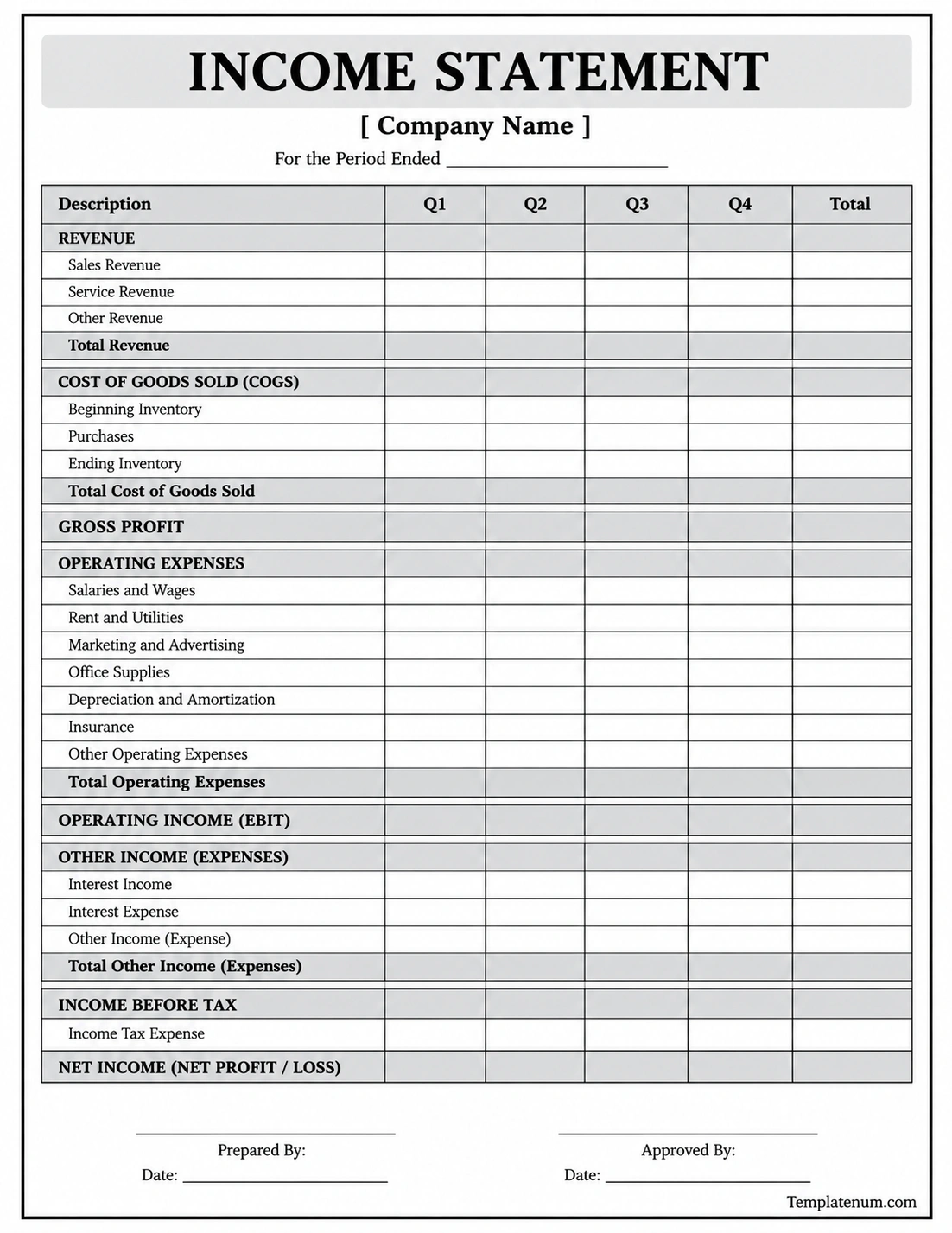
The template includes spaces for company information and the reporting period, along with quarterly columns and an annual total. You can adapt the layout to suit your business and remove or add categories as needed.
For more complex reporting, a spreadsheet or accounting application may be more suitable because it can calculate totals, link financial data, and support comparisons across multiple reporting periods.
How to Prepare an Income Statement
Preparing an income statement requires accurate accounting records and a consistent reporting period. Follow these steps to organize the information and calculate the company’s financial results.
Choose the Reporting Period
Decide whether the statement will cover a month, quarter, or fiscal year. Use consistent start and end dates when comparing financial performance across periods.
Gather Revenue Information
Collect sales records, service invoices, and other relevant revenue information. Reconcile the figures with your accounting records and apply the appropriate revenue recognition policies.
Calculate Cost of Goods Sold
Determine the direct costs associated with the goods sold or services delivered during the period. Businesses that hold inventory may need to consider beginning inventory, purchases, and ending inventory when calculating COGS.
List Operating Expenses
Organize operating expenses into suitable categories, such as payroll, rent, utilities, marketing, insurance, and depreciation. Review transactions carefully to avoid omissions or duplicate entries.
Calculate Profit Figures
Subtract COGS from net revenue to calculate gross profit. Then deduct operating expenses to determine operating income, and account for other income, expenses, and taxes to calculate net income or net loss.
Review and Compare Results
Check the calculations and compare the results with prior periods, budgets, or relevant industry benchmarks. Investigate significant changes and document unusual transactions that could affect interpretation.
How to Analyze an Income Statement
Reading an income statement involves more than identifying whether the company made a profit. Several financial indicators can help explain the quality and sustainability of its performance.
Gross Profit Margin
Gross profit margin measures the percentage of net revenue remaining after COGS.
Formula: Gross Profit Margin = (Gross Profit ÷ Net Revenue) × 100
A declining gross margin may indicate higher production costs, supplier price increases, discounting, or changes in the product mix. The underlying cause should be investigated before making business decisions.
Operating Profit Margin
Operating profit margin measures operating income as a percentage of net revenue.
Formula: Operating Profit Margin = (Operating Income ÷ Net Revenue) × 100
This ratio helps assess how efficiently the company manages its core operations. Comparing it over time can reveal whether operating costs are growing faster than revenue.
Net Profit Margin
Net profit margin shows how much net income the business retains for each dollar of net revenue.
Formula: Net Profit Margin = (Net Income ÷ Net Revenue) × 100
A positive margin indicates that the company reported a profit for the period, while a negative margin indicates a net loss. The result should be compared with previous periods and relevant competitors rather than interpreted in isolation.
Common Income Statement Mistakes to Avoid
Even a well-designed income statement template cannot guarantee accurate results if the underlying information is incomplete or incorrectly classified.
- Mixing reporting periods: Ensure revenue and expenses relate to the same period.
- Misclassifying expenses: Distinguish direct costs, operating expenses, financing costs, and other items appropriately.
- Omitting adjustments: Consider relevant returns, discounts, accruals, depreciation, and other adjustments.
- Confusing profit with cash: A profitable company may still experience cash shortages because profit and cash flow measure different things.
- Ignoring unusual transactions: Identify significant one-time items that may distort comparisons.
- Comparing different accounting methods: Differences in accounting policies can make comparisons between companies less meaningful.
Reviewing these issues before finalizing a report can improve the reliability of financial analysis and support better decisions.
Income Statement vs. Balance Sheet vs. Cash Flow Statement
These three financial statements provide different but complementary views of a company’s financial position and performance.
- Income statement: Reports revenue, expenses, and profit or loss over a period.
- Balance sheet: Reports assets, liabilities, and equity at a specific date.
- Cash flow statement: Reports cash inflows and outflows from operating, investing, and financing activities over a period.
Reviewing all three statements provides a more complete understanding of a business. For example, the income statement may show a profit, while the cash flow statement reveals that customers have not yet paid their invoices.
Frequently Asked Questions About Income Statements
What is the main purpose of an income statement?
The main purpose of an income statement is to show a company’s financial performance over a specific period by reporting revenue, expenses, and resulting net profit or loss. It helps management, investors, and lenders evaluate profitability and operating performance.
What is another name for an income statement?
An income statement is also called a profit and loss statement, P&L statement, or statement of earnings. The terminology may vary by company, industry, and reporting framework.
What are the main components of an income statement?
The main components generally include revenue, cost of goods sold, gross profit, operating expenses, operating income, other income and expenses, income tax expense, and net income or net loss.
How do you calculate net income?
Net income is calculated by subtracting the expenses recognized during the period from the relevant income, including applicable non-operating items and income taxes. The exact presentation depends on the company’s accounting framework.
How often should a company prepare an income statement?
Many companies prepare income statements monthly, quarterly, and annually. Monthly reports support internal management decisions, while quarterly and annual reports help track longer-term performance and meet applicable reporting requirements.
Can a small business use an income statement template?
Yes. A small business can use an income statement template to organize revenue and expenses, calculate profit, and compare results across reporting periods. The template should be adapted to the business’s operations and accounting needs.
Does a profitable income statement mean the company has enough cash?
No. Profit and cash flow are different measures. A company may report a profit while waiting for customers to pay invoices or while using cash to purchase equipment, repay loans, or build inventory.
What is the difference between gross profit and net income?
Gross profit is net revenue minus the cost of goods sold. Net income reflects the remaining profit after accounting for operating expenses, relevant other income and expenses, and income tax expense.
Conclusion
An income statement is an essential financial report for understanding a company’s profitability and operating performance. By organizing revenue, direct costs, operating expenses, and other financial items, it shows whether a business generated a net profit or loss during a specific period.
Using an income statement template can make financial reporting more organized and consistent. Prepare the statement with accurate records, review important profit margins, and compare results across periods to identify trends and potential improvements.
For the most useful analysis, consider the income statement alongside the balance sheet and cash flow statement. Together, these reports provide a broader view of a company’s financial performance, financial position, and cash movement.
Download: Income Statement Template
