An incident report is a formal document used to record unexpected events such as accidents, injuries, property damage, security issues, or near-misses. A well-prepared report creates a clear record of what happened, when and where it happened, who was involved, and what actions were taken afterward.
Organizations use incident reports to investigate events, identify risks, improve workplace safety, and develop corrective measures. They can also support internal procedures, regulatory requirements, insurance processes, and future safety planning.
Whether you work in an office, school, healthcare facility, construction site, retail business, or other organization, having a consistent incident reporting process can make it easier to respond to unexpected events and learn from them.
What Is an Incident Report?
An incident report is a written record that documents an unexpected event or situation. It provides factual information that can later be reviewed by managers, safety teams, human resources departments, investigators, or other authorized personnel.
An incident may involve an actual injury or damage, but it does not always have to. A near-miss incident report, for example, can document an event that could have caused harm but did not result in an injury or loss.
The purpose is not simply to record an event. An effective report helps an organization understand what happened and determine how similar incidents can be prevented.
Why Is an Incident Report Important?
Documenting incidents promptly can provide valuable information for both immediate response and long-term improvement. A consistent reporting process also helps organizations identify patterns that may otherwise be overlooked.
- Creates an official record: The report provides a written account of the event.
- Supports investigation: Accurate details help responsible teams understand what happened.
- Identifies hazards: Reports can reveal unsafe conditions, equipment problems, or procedural weaknesses.
- Encourages corrective action: Organizations can use findings to improve processes and safety measures.
- Helps prevent recurrence: Lessons from previous incidents can guide future prevention efforts.
- Supports compliance: Some workplaces and industries have specific reporting requirements.
- Improves transparency: Consistent documentation creates a more accountable reporting process.
When Should You Complete an Incident Report?
An incident report should generally be completed whenever an unexpected event meets the organization’s reporting criteria. Policies can differ between workplaces, so employees should follow their organization’s established procedures.
Common situations that may require an incident report include:
- Workplace accidents or injuries
- Near-miss events
- Property or equipment damage
- Unsafe conditions
- Security incidents
- Workplace hazards
- Visitor or customer incidents
- Environmental or facility-related incidents
- Events requiring emergency response
When in doubt, follow the organization’s reporting policy or ask the appropriate supervisor or safety representative how the event should be documented.
What Should an Incident Report Include?
A useful incident report should contain enough information to help someone understand the event without relying on assumptions or incomplete recollections. The exact format can vary, but several sections are commonly included.
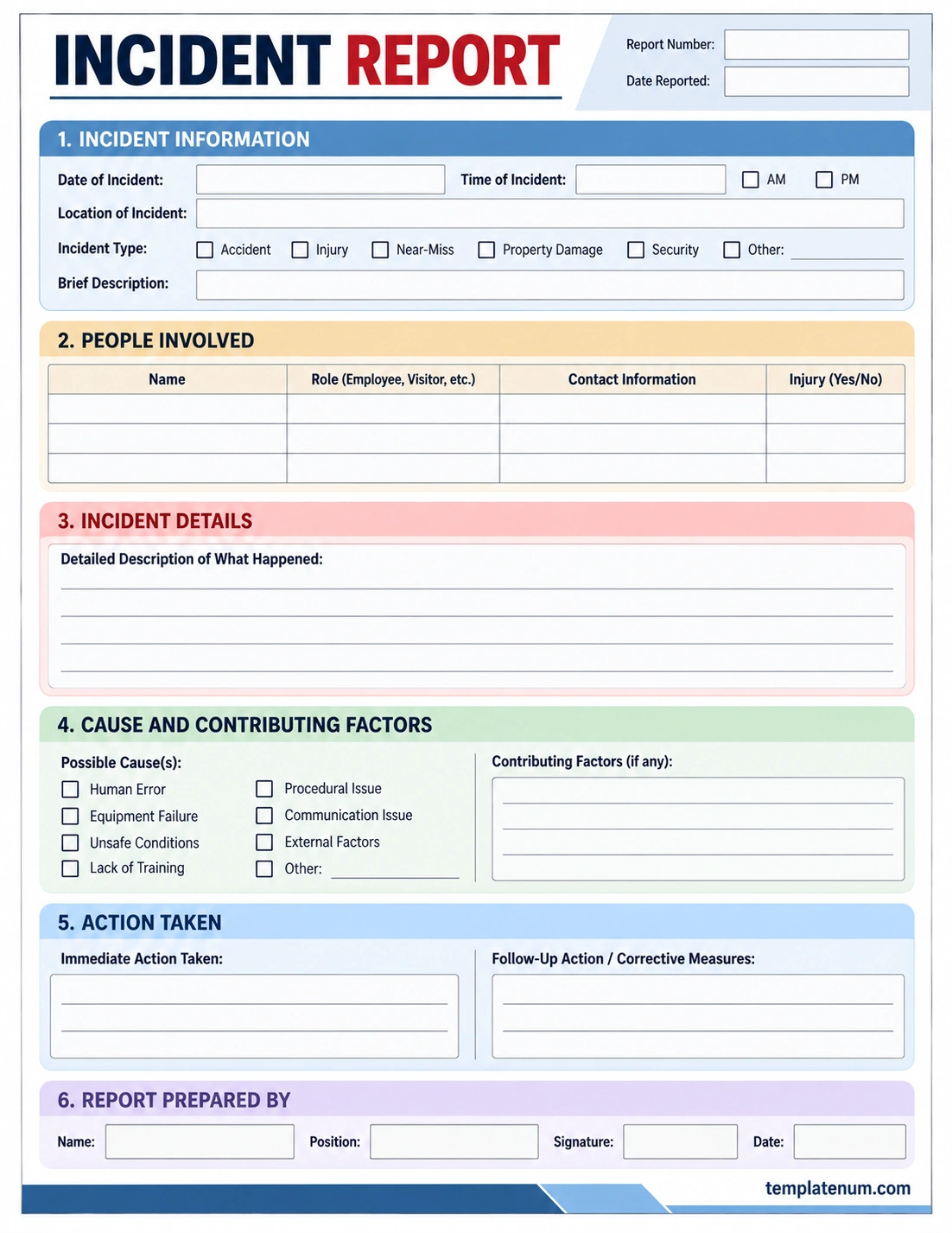
1. Basic Incident Information
Start with the essential details of the event. Include the date, time, location, and type of incident whenever that information is available.
- Date of the incident
- Time of the incident
- Exact or general location
- Type of incident
- Report number, if applicable
- Date the report was prepared
2. People Involved
Record relevant information about people directly involved in the incident. Depending on organizational policy, this may include employees, contractors, visitors, customers, or witnesses.
Only collect and document information that is appropriate for the organization’s reporting process. Sensitive personal information should be handled according to applicable privacy policies and requirements.
3. Description of What Happened
This is one of the most important parts of an incident report. Describe the event in a clear, chronological manner. Focus on observable facts rather than assumptions about someone’s intentions or motivations.
For example, instead of writing that an employee was careless, describe the observable circumstances that led to the incident. Factual wording makes the report more useful for later review.
4. Causes and Contributing Factors
If known, document potential causes or contributing conditions. These might include equipment failure, unsafe conditions, communication problems, procedural issues, environmental factors, or training gaps.
A preliminary report does not always need to establish the final root cause. If an investigation is still underway, clearly distinguish confirmed facts from information that requires further review.
5. Immediate and Corrective Actions
Document what was done immediately after the incident and identify any follow-up actions that may be required.
- Emergency response provided
- Area secured or restricted
- Equipment removed from service
- Hazard corrected
- Supervisor or safety team notified
- Additional investigation requested
- Preventive or corrective measures planned
6. Report Preparation Details
Include the name, position, signature, and date of the person preparing the report when required by organizational procedures. This helps establish when and by whom the documentation was created.
How to Write an Effective Incident Report
Writing an effective report does not require complicated language. The goal is to communicate accurate information clearly and efficiently.
Use Objective Language
Keep the report factual and neutral. Avoid emotional language, speculation, exaggeration, or statements that cannot be supported by available information.
Instead of saying that someone was “extremely careless,” describe the specific action or condition that was observed.
Write in Chronological Order
Present events in the order they occurred whenever possible. A chronological description makes it easier for another person to understand the sequence of events.
Include Specific Details
Useful details can include the location, equipment involved, environmental conditions, actions immediately before the incident, and actions taken afterward. Avoid unnecessary information that does not help explain the event.
Separate Facts From Assumptions
Only state conclusions that are supported by available evidence. If the cause has not yet been determined, indicate that further investigation may be necessary.
Review the Report Before Submission
Check names, dates, times, locations, descriptions, and other important details before submitting the report. Correct obvious errors while the information is still fresh.
Incident Report Example
A basic incident report might describe an event such as equipment damage in a workplace. The report could begin by identifying the date, time, and location. It could then explain what was observed, identify people who were present, document any immediate action, and note whether further investigation is required.
For example, a factual description could state that an employee reported unusual equipment movement at a specific time, the equipment was stopped, and the area was temporarily restricted while a supervisor inspected the equipment. If the cause has not yet been confirmed, the report should not present an assumption as a final finding.
This approach keeps the incident report focused on useful facts and provides a foundation for further investigation.
How to Use an Incident Report Template
An incident report template can make documentation more consistent by providing predefined sections for important information. Instead of starting with a blank page, the person completing the report can work through each relevant section.
A practical template may include fields for incident information, people involved, incident details, contributing factors, immediate actions, corrective measures, and report preparation information.
When using a template, customize it to match the organization’s policies, industry requirements, and reporting procedures. A template should support the reporting process rather than replace official rules or required documentation.
Common Incident Report Mistakes to Avoid
Small documentation problems can make an incident report less useful. Avoid these common mistakes when preparing a report.
- Waiting too long: Delayed reporting can make important details harder to remember.
- Using vague language: General statements may not provide enough useful information.
- Including unsupported assumptions: Speculation can interfere with an objective investigation.
- Leaving important fields blank: Missing dates, locations, or descriptions can create gaps in the record.
- Using emotional language: Neutral wording is generally more appropriate for formal documentation.
- Ignoring near-misses: Events without injuries can still reveal serious safety risks.
- Failing to document follow-up: Corrective actions should be recorded when applicable.
Tips for Better Incident Reporting
Organizations can improve their reporting process by making incident documentation simple, accessible, and consistent.
- Keep incident reporting forms easy to access.
- Train employees on when and how to report incidents.
- Use consistent terminology throughout the organization.
- Encourage factual and timely reporting.
- Review reports for recurring hazards or patterns.
- Track corrective actions through completion.
- Update reporting procedures when organizational needs change.
It is also important to create a workplace culture where employees understand that reporting an incident or near-miss is intended to improve safety and identify risks rather than simply assign blame.
Incident Report vs. Accident Report
The terms incident report and accident report are sometimes used interchangeably, but they can have different meanings depending on the organization.
An accident report often focuses specifically on an event that resulted in injury, damage, or another measurable loss. An incident report can have a broader meaning and may include accidents, near-misses, unsafe conditions, security events, and other unexpected occurrences.
Because terminology varies, always follow the definitions and reporting requirements established by your organization.
Frequently Asked Questions About Incident Reports
What is the main purpose of an incident report?
The main purpose is to create an accurate record of an unexpected event. The information can support investigation, corrective action, risk identification, safety improvements, and appropriate compliance procedures.
What should be included in an incident report?
An incident report commonly includes the date, time, location, incident type, people involved, factual description, contributing factors, immediate actions, corrective measures, and information about the person preparing the report.
Should a near-miss be documented?
Many organizations document near-misses because they can reveal hazards before someone is injured or property is damaged. Follow the reporting requirements established by the relevant organization or workplace.
Should an incident report include opinions?
An incident report should generally focus on objective, verifiable information. Opinions and assumptions should not be presented as facts. If an investigation requires professional conclusions, those findings can be documented through the appropriate process.
When should an incident report be completed?
It should generally be completed as soon as reasonably possible after the event, according to the organization’s reporting procedure. Prompt documentation can help preserve accurate details.
Can an incident report be used for workplace safety improvement?
Yes. Incident reports can help organizations identify recurring hazards, evaluate procedures, implement corrective actions, and reduce the likelihood of similar events occurring in the future.
Conclusion
An incident report provides an organized way to document unexpected events and create a reliable record for future review. A strong report focuses on facts, includes relevant details, identifies contributing factors when known, and records immediate and corrective actions.
Using a consistent incident reporting process can help organizations investigate events more effectively, identify risks, improve workplace safety, and maintain better documentation. An incident report template can further simplify the process by giving employees a clear structure for recording important information.
Download: Incident Report Template
