A lab report is an important part of scientific learning and research. It provides a structured way to document an experiment, explain the procedures used, present observations, and communicate the results. Whether you are completing a school science assignment or conducting a more advanced laboratory investigation, a well-organized report helps others understand what you did and what you discovered.
Writing a lab report does not have to be difficult. By following a clear structure, you can organize your scientific information and explain your findings in a logical order. Most reports include an objective, hypothesis, materials, methods, results, discussion, and conclusion.
A printable lab report template can make this process easier by providing dedicated spaces for each section. It also helps students remember important details and present experimental findings more clearly.
In this guide, you will discover different lab report templates, learn what to include in each section, and find practical tips for writing an accurate and effective scientific report.
What Is a Lab Report?
A lab report is a written document that describes a scientific experiment and communicates its methodology, observations, results, and conclusions. It explains what the researcher wanted to investigate, how the experiment was conducted, and what the collected data revealed.
The main purpose of a laboratory report is to communicate scientific findings in a clear, organized, and reproducible manner. Other readers should be able to understand the experiment and evaluate whether the conclusions are supported by the evidence.
Lab reports are commonly used in:
- School science classes and laboratory assignments.
- High school biology, chemistry, and physics experiments.
- College and university laboratory courses.
- Scientific research projects.
- Professional laboratory investigations.
- Environmental and engineering experiments.
Although the required format may differ depending on the institution or research field, most laboratory reports follow a similar scientific structure.
Free Printable Lab Report Templates
A printable lab report template provides a convenient framework for organizing experiment details. Instead of creating a document from scratch, students can use predefined sections to record their objectives, procedures, measurements, and findings.
Here are three different printable layouts designed for various laboratory reporting needs.
1. Basic Lab Report Template
This template is suitable for students who need a straightforward worksheet for documenting a science experiment. It includes spaces for the experiment title, student information, aim, hypothesis, materials, method, results, and conclusion.

This layout works well for classroom experiments and introductory science assignments. Its straightforward structure makes it easier for students to follow the scientific method.
2. Lab Report Analysis and Conclusion Template
This landscape template focuses on interpreting experimental findings. It includes dedicated sections for data analysis, sources of error, discussion, reproducibility notes, and final conclusions.
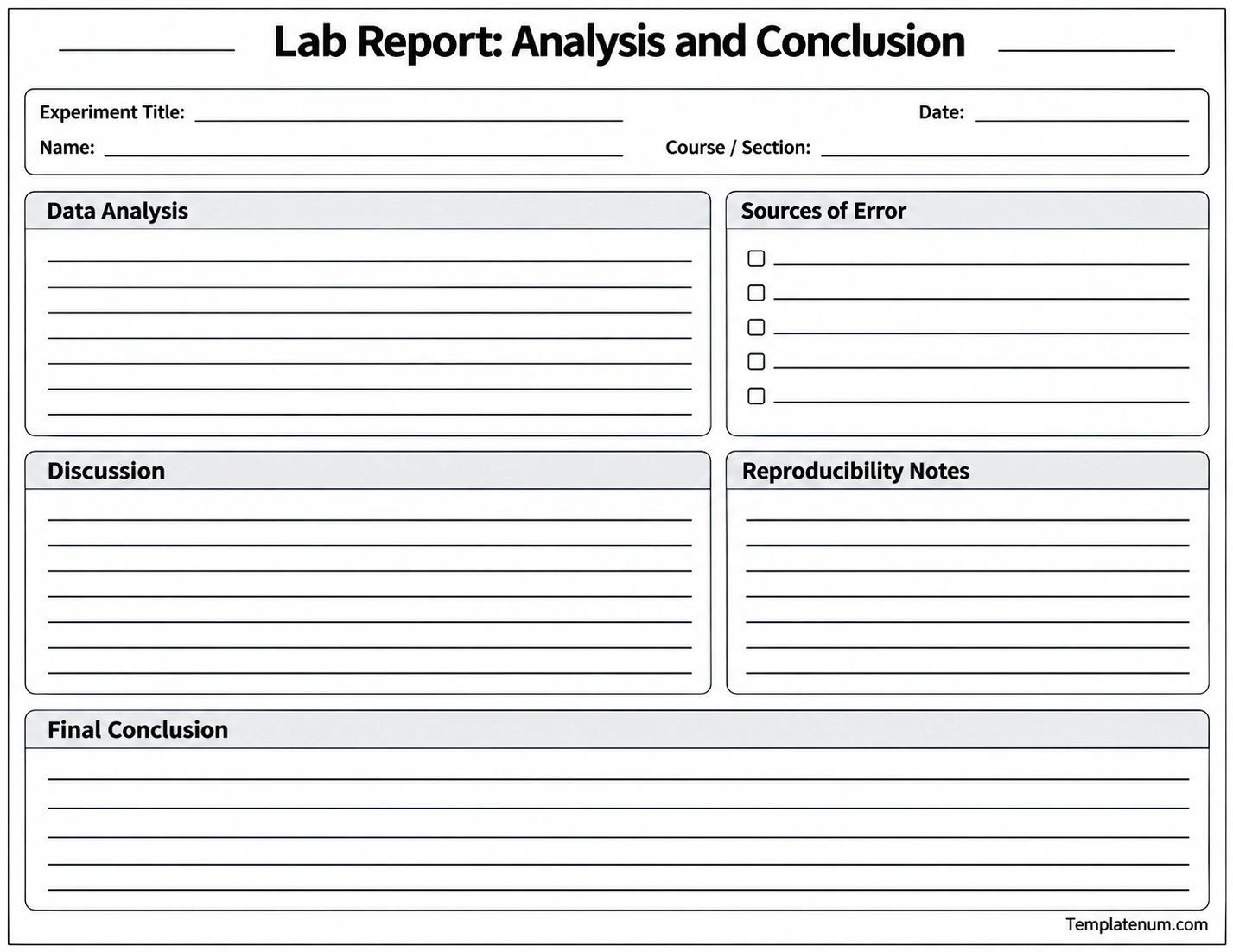
It is particularly useful when an experiment requires more detailed interpretation rather than simply recording observations.
3. Lab Report Data and Observations Template
This template is designed for recording experimental measurements and observations. It includes sections for objectives, independent and dependent variables, controlled variables, trial measurements, observations, and results.
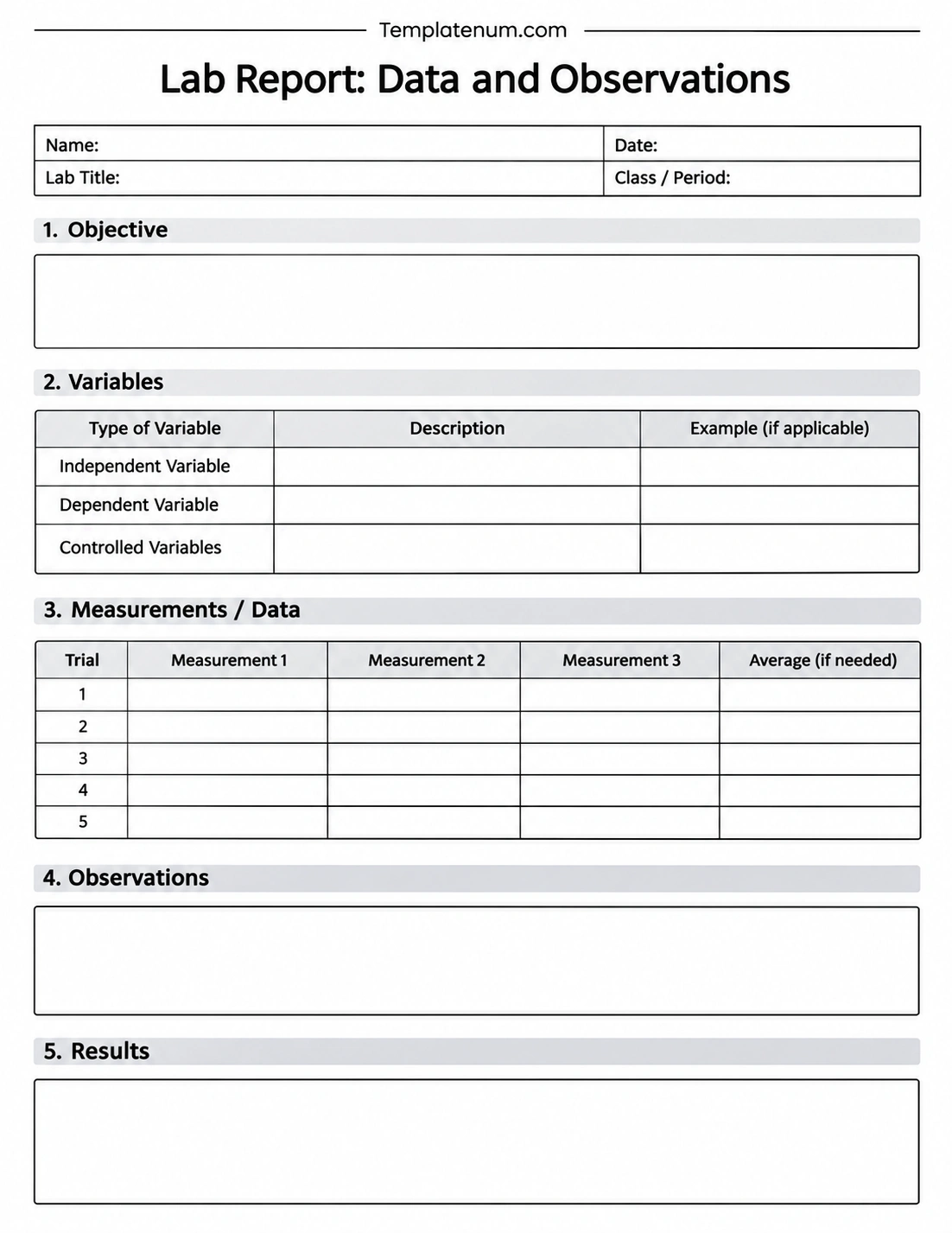
This design is useful for experiments involving repeated trials, numerical measurements, and comparisons between different experimental conditions.
What Are the Main Sections of a Lab Report?
A complete lab report usually contains several sections that explain different stages of the experiment. Understanding the purpose of each section can help you prepare a more accurate and organized document.
1. Title
The title identifies the experiment and gives readers an immediate idea of what the investigation is about. Choose a short, descriptive title that clearly communicates the subject of the experiment.
2. Objective or Purpose
The objective explains what the experiment is designed to investigate. It should clearly state the scientific question or problem being studied.
For example, an experiment might investigate how temperature affects the rate at which sugar dissolves in water.
3. Hypothesis
A hypothesis is a testable prediction about what you expect to happen during the experiment. It is usually based on previous knowledge, observations, or scientific reasoning.
A useful hypothesis identifies the expected relationship between the variables being investigated.
4. Materials and Equipment
This section lists the materials, tools, chemicals, and equipment required to complete the experiment.
Include enough information for another person to understand what was used and prepare the same investigation.
5. Method or Procedure
The method explains how the experiment was performed. Write the steps in chronological order and include important measurements, quantities, conditions, and timings.
A clear procedure helps other researchers understand and potentially reproduce the experiment.
6. Results and Observations
This section presents the information collected during the experiment. Results may include numerical measurements, tables, graphs, photographs, and written observations.
Keep the presentation factual and organized. Explain what you observed without confusing raw results with interpretations.
7. Discussion and Analysis
The discussion explains what the experimental results mean. Compare the findings with your original hypothesis and discuss possible reasons for the observed outcomes.
You should also identify unexpected results, limitations, and potential sources of experimental error.
8. Conclusion
The conclusion summarizes the most important findings and explains whether the results support the original hypothesis.
Refer to the collected evidence when explaining your conclusion. Avoid introducing new experimental results that were not discussed earlier.
9. References
If you used textbooks, research papers, websites, or other scientific sources, include them in the required citation format. Follow your instructor’s or institution’s referencing guidelines.
How to Write a Lab Report Step by Step
Writing a laboratory report becomes easier when you approach each section systematically. The following steps can help you prepare a clear and informative report.
Step 1: Understand the Experiment
Before writing, make sure you understand the purpose of the investigation. Identify the scientific question, the variables, and the expected outcome.
Step 2: Record the Materials and Procedure
Document the equipment and materials used during the experiment. Write down the procedure accurately, including important measurements and conditions.
Step 3: Organize Your Experimental Data
Arrange your measurements and observations in tables or other suitable formats. Include measurement units and clearly identify each trial.
If your experiment involves repeated measurements, calculate averages or other relevant statistics when appropriate.
Step 4: Present the Results
Use tables, graphs, and written descriptions to communicate the experimental findings. Make sure every figure has a clear title and appropriate labels.
Step 5: Analyze the Findings
Look for patterns, relationships, and differences in your results. Explain whether the observations agree with your hypothesis and identify any unexpected outcomes.
Step 6: Write the Conclusion
Summarize the main findings and answer the original research question. Explain whether the hypothesis was supported, partially supported, or not supported by the evidence.
Step 7: Review and Edit
Check your report for missing information, calculation errors, unclear explanations, and formatting problems. Make sure the final document follows the required assignment guidelines.
Tips for Writing a Good Lab Report
A strong laboratory report should be clear, accurate, objective, and easy to follow. These practical tips can help improve the quality of your scientific writing.
- Use clear language: Explain scientific concepts in direct and understandable sentences.
- Be objective: Report what happened during the experiment rather than what you expected to happen.
- Include accurate measurements: Record numerical results with appropriate units and precision.
- Organize information logically: Use headings and subheadings to separate different sections.
- Label tables and graphs: Provide clear titles, units, and axis descriptions.
- Explain unexpected results: Discuss possible reasons for unusual observations.
- Avoid unsupported conclusions: Base your interpretation on the experimental evidence.
- Follow the required format: Check your teacher’s or institution’s instructions before submitting the report.
- Proofread carefully: Correct spelling, grammar, calculations, and formatting mistakes.
Common Lab Report Mistakes to Avoid
Even when an experiment is performed correctly, mistakes in the written report can make the findings difficult to understand. Pay attention to these common problems when preparing your document.
Writing a Vague Objective
An unclear objective makes it difficult to understand the purpose of an experiment. State exactly what you want to investigate.
Leaving Out Important Method Details
Missing measurements, quantities, or procedural steps can make an experiment difficult to reproduce. Include enough detail to explain how the investigation was conducted.
Confusing Results with Discussion
Results should present the collected evidence, while the discussion interprets that evidence. Keeping these sections separate improves clarity.
Ignoring Experimental Errors
Every experiment has limitations. Discuss possible measurement errors, equipment limitations, uncontrolled variables, or procedural issues that could have affected the results.
Making Unsupported Conclusions
Your conclusion should reflect the actual findings. Do not claim that an experiment proves something when the available evidence only suggests a possible relationship.
Frequently Asked Questions About Lab Reports
What is the main purpose of a lab report?
The main purpose of a lab report is to communicate the objective, methodology, results, and conclusions of a scientific experiment. It allows readers to understand the investigation, evaluate the evidence, and assess whether the findings can be reproduced.
What are the five main parts of a lab report?
A basic lab report commonly includes an introduction or objective, hypothesis, materials and methods, results, and conclusion. More detailed reports may also include a discussion, references, and an abstract.
How long should a lab report be?
The length depends on the complexity of the experiment and the assignment requirements. A short school laboratory report may only need a few pages, while a university or professional research report may be considerably longer.
Should a lab report be written in past tense?
Methods and completed experimental procedures are generally written in the past tense because they describe actions that have already occurred. Scientific facts and established principles may be written in the present tense.
What is the difference between results and discussion?
The results section presents the data and observations collected during the experiment. The discussion explains what those findings mean, compares them with the hypothesis, and considers possible errors or limitations.
Can I use a lab report template for school assignments?
Yes. A printable lab report template can help students organize experimental information and remember important sections. However, always check your teacher’s instructions because some assignments require a specific format.
What should be included in a lab report conclusion?
A conclusion should summarize the main findings, answer the original research question, and explain whether the hypothesis was supported by the results. It may also mention important limitations or suggestions for further investigation.
Why are graphs and tables important in a lab report?
Graphs and tables make experimental data easier to organize, compare, and interpret. They help readers identify patterns and relationships that may be difficult to understand from written descriptions alone.
Can I write a lab report in first person?
It depends on the assignment or publication guidelines. Some scientific reports prefer an objective writing style that avoids unnecessary personal language, while others allow first-person descriptions. Follow the required style for your course or institution.
Conclusion
A lab report is an essential document for communicating scientific experiments and their findings. It provides a structured explanation of the research objective, hypothesis, materials, methods, observations, results, and conclusions.
Using a printable lab report template can make scientific writing easier by organizing important information into clearly defined sections. Whether you need a basic experiment worksheet, a data recording sheet, or a detailed analysis template, choosing the right layout can help you prepare a more complete report.
Download and print your preferred lab report template, record your experimental information carefully, and review your findings before submission. With clear organization and accurate scientific writing, you can communicate your results effectively and make your laboratory work easier to understand and evaluate.
Download: Lab Report Template Word
