In this guide, you will learn how to write a professional letter of interest for a job, what to include, and how to make your message stand out. You will also find practical examples and a sample letter you can customize for your own job search.
What Is a Letter of Interest for a Job?
A letter of interest for a job, also called a letter of intent or statement of interest, is a professional message sent to an employer to express your desire to work for their organization. It introduces your background, relevant qualifications, and reasons for wanting to join the company, even when there is no advertised vacancy.
The main purpose is to establish a professional connection and communicate the value you could offer. Rather than applying for a specific position, you are asking the employer to consider you for potential opportunities that match your experience and skills.
A letter of interest may be useful when you:
- Want to work for a company that does not currently advertise suitable positions.
- Have identified an organization that matches your career goals.
- Are interested in future vacancies within a particular department.
- Want to introduce yourself to a hiring manager or recruiter.
- Have professional connections who recommend contacting an employer directly.
Letter of Interest vs. Cover Letter: What Is the Difference?
Although a letter of interest and a cover letter share similar elements, they serve different purposes. Understanding the distinction helps you choose the right approach when contacting an employer.
A cover letter is generally written in response to a specific job advertisement. It explains why you are suitable for that particular position and connects your experience to the employer’s stated requirements.
In contrast, a letter of interest is usually unsolicited. It communicates your enthusiasm for the organization and introduces your qualifications without referring to a specific advertised role.
- Cover letter: Focuses on a particular job opening and explains why you are qualified for it.
- Letter of interest: Focuses on the company and expresses interest in potential current or future opportunities.
- Letter of intent: A broader term whose meaning depends on the context. In employment, it may refer to a statement of interest in joining an organization.
- Statement of interest: Often used to describe a written explanation of professional interests, goals, and qualifications.
Both documents should be professional, concise, and tailored to the recipient. However, a letter of interest should emphasize why you want to work for the organization rather than simply responding to a job description.
What to Include in a Letter of Interest for a Job
A strong letter of interest should give employers enough information to understand your background and potential value. Organize your message into clear sections so the hiring manager can quickly identify your purpose.
1. Your Contact Information
Start with your full name, phone number, email address, and location. Include the date and the recipient’s name, job title, company name, and address when available.
2. A Professional Opening
Address the hiring manager by name whenever possible. If you cannot identify the appropriate contact, use a professional greeting such as “Dear Hiring Manager.”
3. A Clear Statement of Interest
Explain why you are contacting the company. Mention the organization by name and briefly describe what attracts you to its work, values, products, or professional environment.
4. Relevant Skills and Experience
Highlight two or three qualifications that demonstrate your potential value. These may include professional experience, technical abilities, leadership, communication, project management, or relevant achievements.
5. Your Reason for Choosing the Company
Show that you have researched the organization. Refer to a specific project, company achievement, business approach, or workplace value that genuinely interests you.
6. A Professional Closing
Thank the recipient for considering your message. Express your willingness to discuss potential opportunities and mention that your resume is attached if applicable.
How to Write a Letter of Interest for a Job
Writing an effective letter does not have to be complicated. Follow these steps to create a personalized message that communicates your qualifications and enthusiasm.
Step 1: Research the Company
Before writing, learn about the organization’s products, services, recent projects, workplace culture, and business goals. This research helps you explain why you want to work there and prevents your letter from sounding generic.
Step 2: Identify Your Relevant Strengths
Consider which skills and experiences would be valuable to the organization. Focus on qualifications that relate to the type of work you hope to perform rather than listing everything on your resume.
Step 3: Write an Engaging Introduction
Start with a direct explanation of your interest. Mention the company and briefly introduce your professional background. Your opening should make it clear why you are reaching out.
Step 4: Demonstrate Your Potential Value
Use specific examples to support your claims. Instead of saying you are an excellent problem-solver, describe how you improved a process, resolved a workplace challenge, or helped a team achieve a measurable result.
Step 5: Personalize Your Message
Avoid sending the same letter to every employer. Adjust your introduction, skills, and reasons for applying to reflect each organization’s needs and professional environment.
Step 6: End with a Clear Call to Action
Close by inviting the hiring manager to contact you about potential opportunities. Keep the request polite and professional without making the recipient feel pressured.
Sample Letter of Interest for a Job
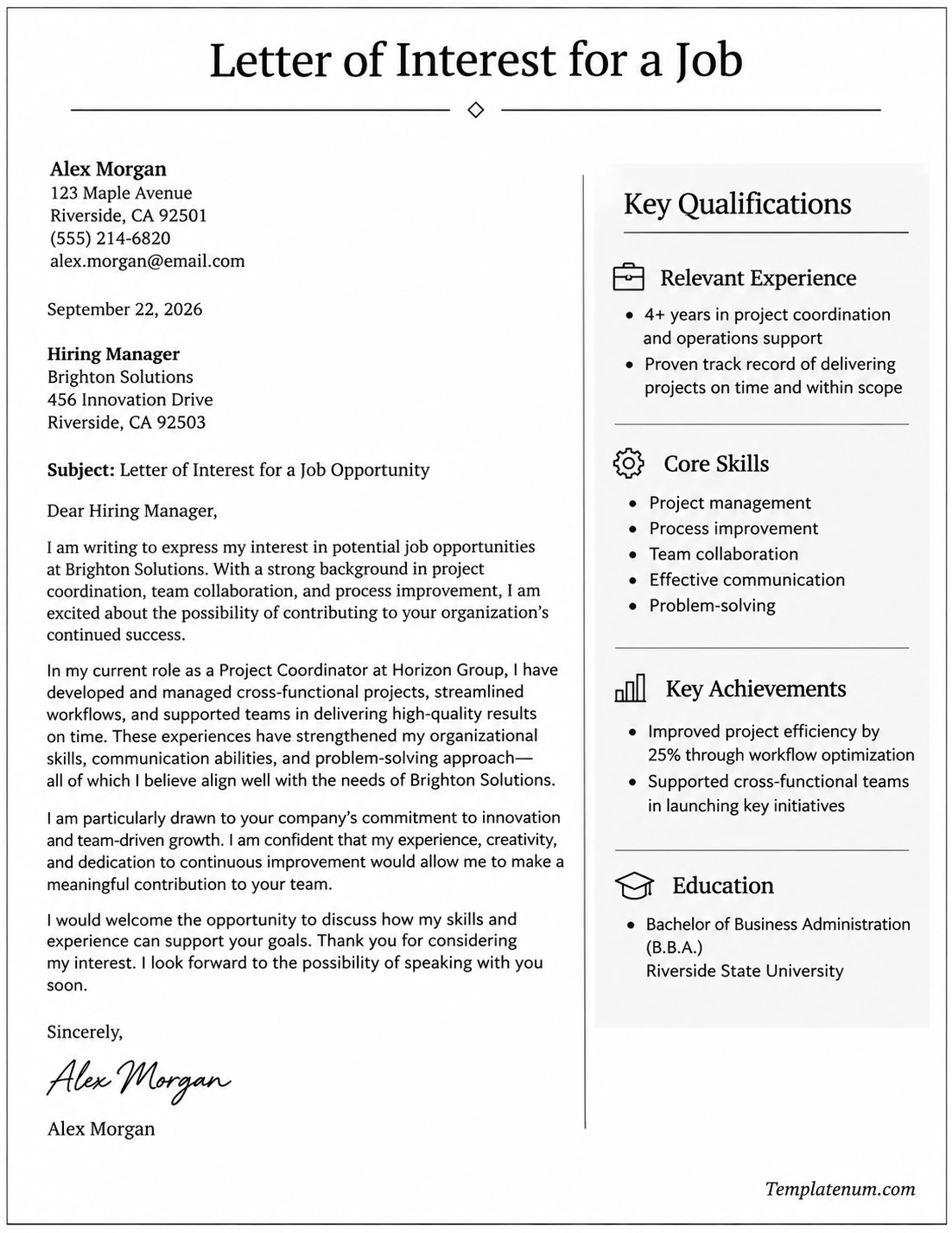
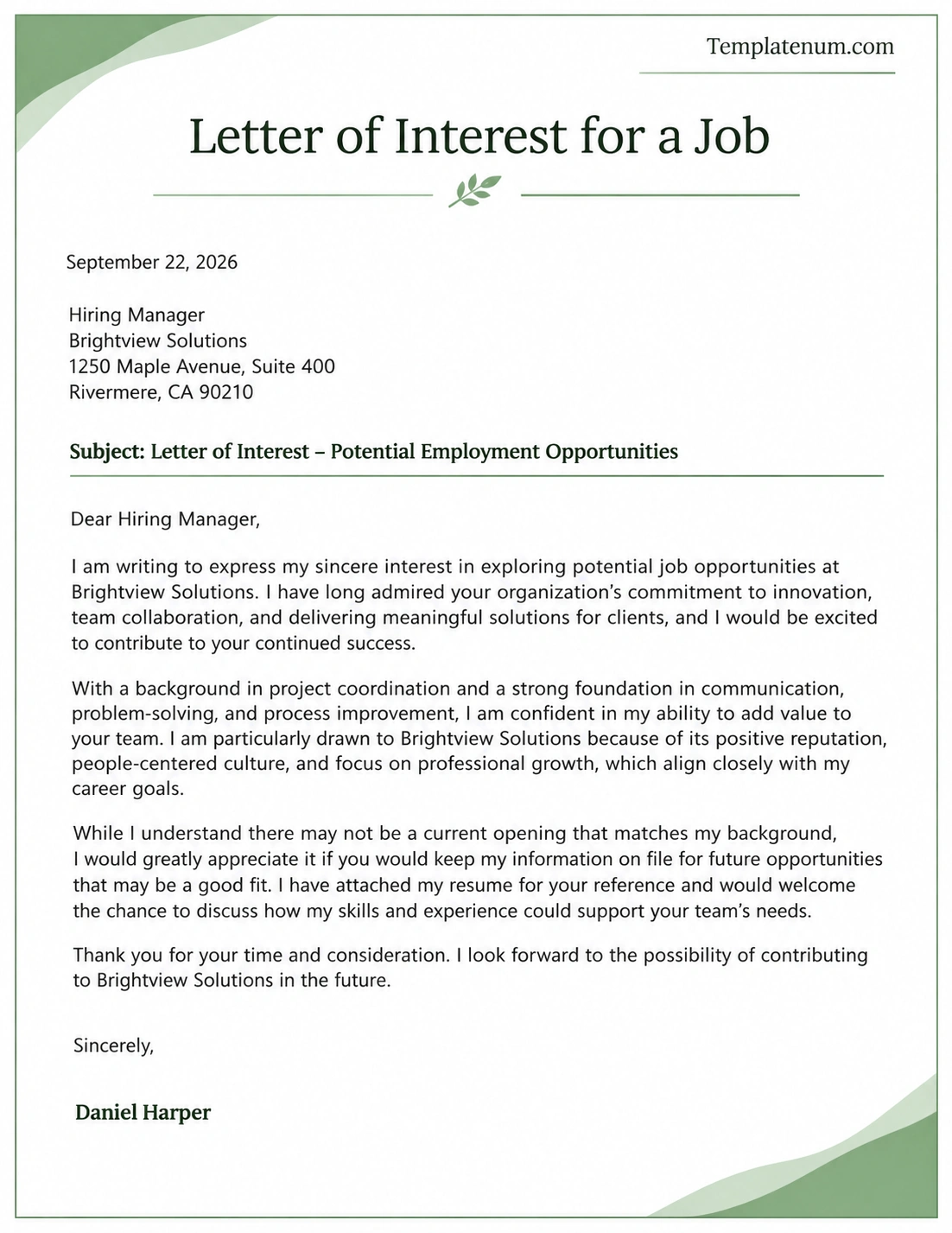
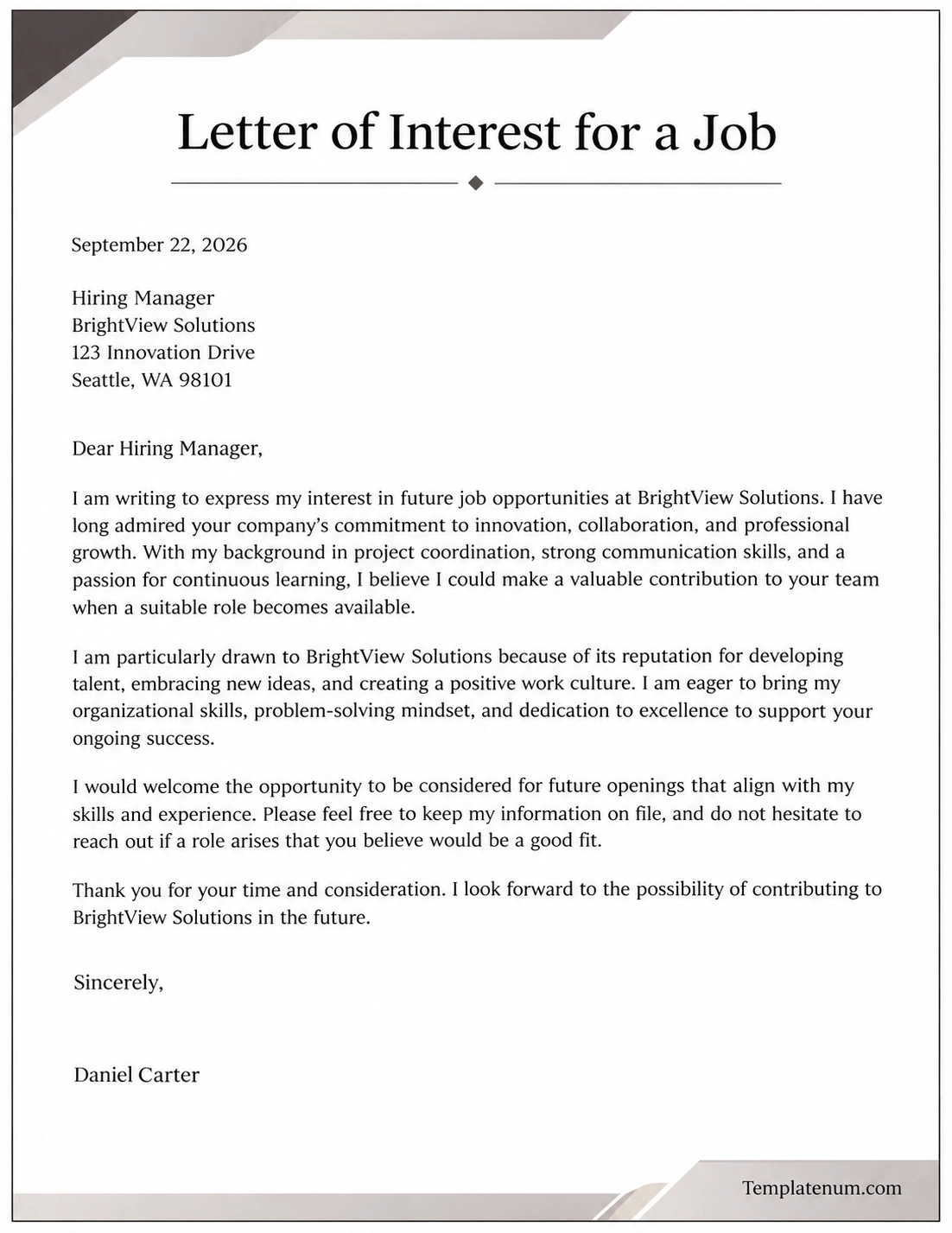
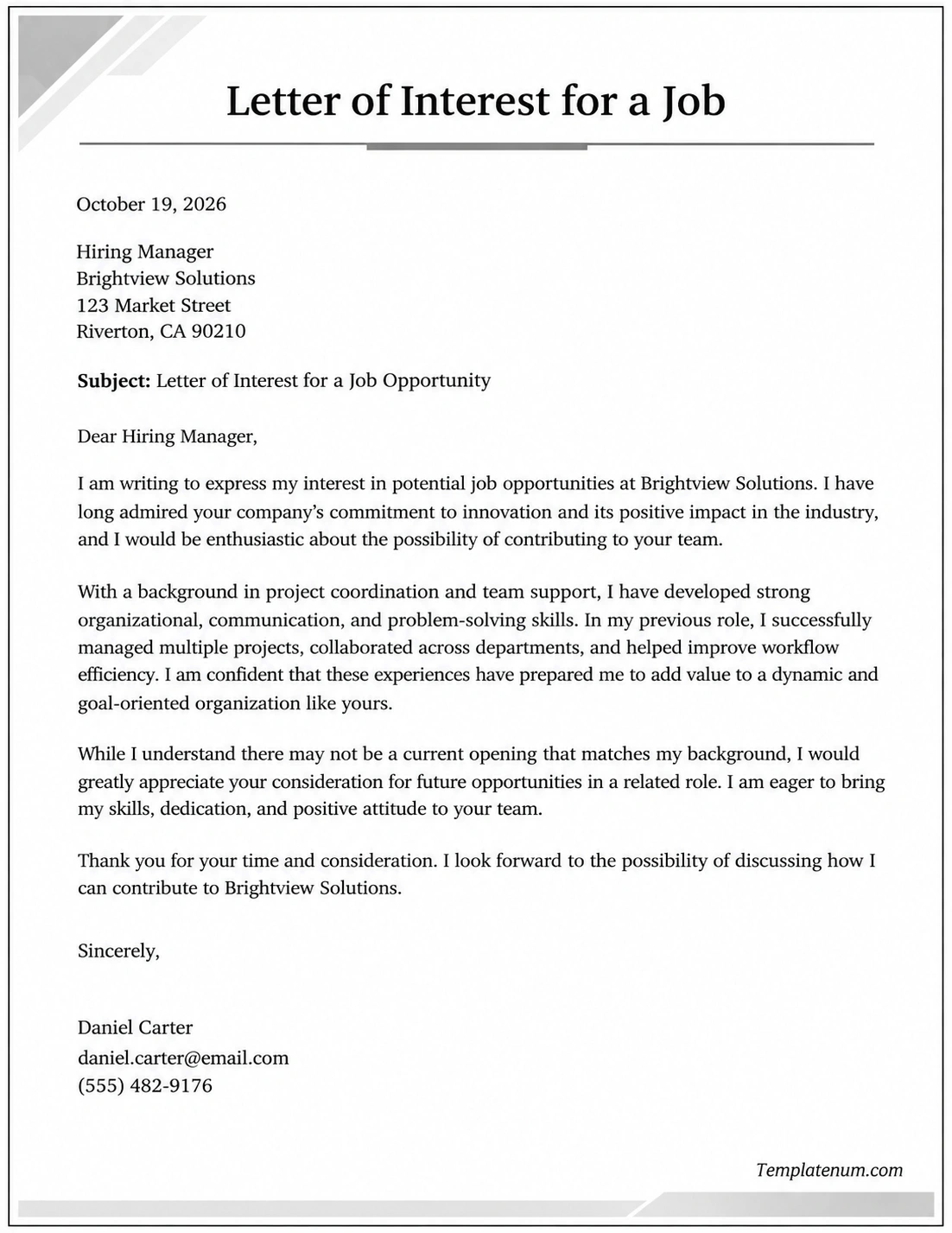
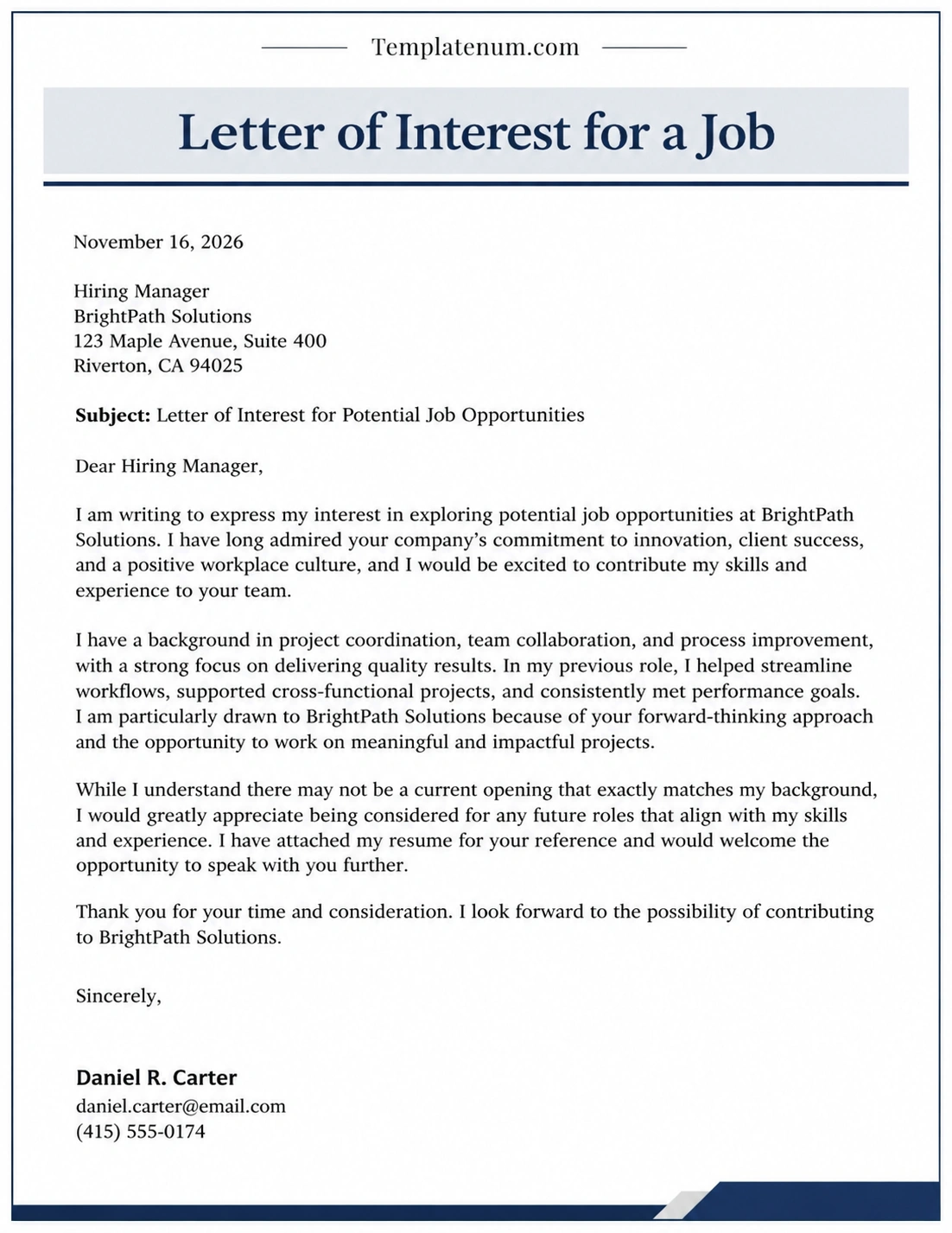
The following sample demonstrates how to express interest in an organization when no specific position has been advertised. You can customize the company details, professional experience, and skills to match your situation.
Sample Letter of Interest for a Job – General Professional Example
Daniel Carter
123 Maple Avenue
Seattle, WA 98101
daniel.carter@email.com
(555) 214-6820September 22, 2026
Hiring Manager
BrightView Solutions
456 Innovation Drive
Seattle, WA 98101Subject: Letter of Interest for Future Employment Opportunities
Dear Hiring Manager,
I am writing to express my interest in exploring potential employment opportunities at BrightView Solutions. I have followed your company’s work and admire its commitment to innovation, collaboration, and delivering meaningful results for clients.
With a background in project coordination and team support, I have developed strong organizational, communication, and problem-solving skills. In my previous role, I helped manage multiple projects, coordinate cross-functional activities, and improve daily workflows. I believe these experiences would allow me to make a positive contribution to your organization.
I am particularly interested in BrightView Solutions because of its reputation for professional development and its forward-thinking approach. I would welcome the opportunity to contribute my experience, enthusiasm, and dedication to a team that values continuous improvement.
Although I understand there may not be a current opening that matches my qualifications, I would appreciate being considered for future opportunities. I have attached my resume for your review and would be pleased to discuss how my background could support your organization’s goals.
Thank you for your time and consideration. I look forward to the possibility of speaking with you.
Sincerely,
Daniel Carter
This sample can be adapted for different industries, experience levels, and career goals. Remember to replace the example details with accurate information about yourself.
Professional Letter of Interest Examples for Different Situations
The structure of your letter may change depending on your career stage and the type of opportunity you are pursuing. Here are several situations where a customized approach can make your message more effective.
Letter of Interest for an Entry-Level Job
If you have limited professional experience, emphasize your education, internships, volunteer work, transferable skills, and willingness to learn. Explain why the company interests you and how your abilities could support its team.
Letter of Interest for an Experienced Professional
Experienced candidates should focus on their strongest accomplishments, industry knowledge, and relevant expertise. Include measurable results whenever possible to demonstrate the value they could bring to a prospective employer.
Letter of Interest for an Internal Position
Employees who want to explore opportunities within their current organization can use a letter of interest to communicate their career goals. Highlight your understanding of company operations, existing contributions, and qualifications for another department or role.
Letter of Interest for a Career Change
When changing careers, explain what motivates your transition and identify transferable skills that apply to your desired field. Relevant training, certifications, personal projects, and volunteer experience can strengthen your message.
Tips to Make Your Letter of Interest Stand Out
A professional letter should do more than announce that you want a job. It should give the employer a clear reason to consider you. Use these practical tips to strengthen your message.
- Keep it concise: Aim for approximately 250 to 400 words, using short paragraphs and straightforward language.
- Research the recipient: Address the appropriate hiring manager, recruiter, or department head whenever possible.
- Be specific: Explain what interests you about the company instead of relying on generic compliments.
- Highlight achievements: Include relevant accomplishments that demonstrate your professional capabilities.
- Use a professional tone: Be confident, respectful, and enthusiastic without exaggerating your qualifications.
- Attach your resume: Provide a current resume so the employer can review your experience in greater detail.
- Proofread carefully: Check grammar, spelling, formatting, names, and contact information before sending.
- Follow up appropriately: If you do not receive a response, consider sending a brief and courteous follow-up after about one or two weeks.
Common Mistakes to Avoid
Even a well-qualified candidate can make a poor impression with an unfocused or overly generic message. Avoid these common mistakes when preparing your letter.
- Using a generic template without customization: Employers want to understand why you are interested in their particular organization.
- Focusing only on personal benefits: Explain what you can contribute rather than discussing only what you hope to gain.
- Repeating your entire resume: Select the most relevant qualifications instead of copying your work history into the letter.
- Making unsupported claims: Use realistic examples and evidence to support statements about your abilities.
- Writing too much: A lengthy letter can make your main message difficult to identify.
- Assuming a job is available: Clearly communicate that you are exploring potential opportunities rather than applying for an unadvertised position.
- Forgetting contact information: Make it easy for employers to reach you if they are interested.
How to Send a Letter of Interest
Once your letter is ready, choose an appropriate way to contact the organization. Email is often the most convenient option because it allows you to introduce yourself and attach your resume in one message.
When sending your letter by email, consider the following recommendations:
- Use a clear subject line: For example, “Letter of Interest – Future Employment Opportunities.”
- Keep the email message brief: Introduce yourself and explain that your letter and resume are attached.
- Choose appropriate attachments: Save your documents as PDF files to preserve their formatting.
- Use professional filenames: For example, Daniel_Carter_Letter_of_Interest.pdf and Daniel_Carter_Resume.pdf.
- Verify the recipient: Check the company’s official website or professional directory for the correct contact information.
If you send a printed letter, use clean, professional formatting and quality paper. Make sure the recipient’s name and mailing address are correct before sending it.
Frequently Asked Questions
1. What is a letter of interest for a job?
A letter of interest for a job is an unsolicited professional letter sent to a company to express your desire to work there. It introduces your qualifications and explains why you would like to be considered for potential employment opportunities, even when no specific vacancy is advertised.
2. Is a letter of interest the same as a letter of intent?
The terms are sometimes used interchangeably in job searches. Both can communicate a candidate’s intention to pursue employment. However, the exact meaning of a letter of intent depends on the employment context, so it is important to consider the recipient’s expectations.
3. How long should a letter of interest be?
A letter of interest should generally be around 250 to 400 words and fit comfortably on one page. Keep the message focused on your professional background, relevant skills, interest in the company, and potential value.
4. Should I include my resume with a letter of interest?
Yes. Attaching your resume is generally recommended because it gives the employer additional information about your experience, education, and qualifications. Make sure the resume supports the information presented in your letter.
5. Can I send a letter of interest without a job opening?
Yes. That is one of the main purposes of this letter. You can contact an organization proactively to express interest in future vacancies or opportunities that match your background.
6. Who should I address my letter of interest to?
Whenever possible, address the letter to the hiring manager, recruitment manager, or department head responsible for your desired field. If you cannot find a specific name, “Dear Hiring Manager” is an appropriate professional greeting.
7. Should I follow up after sending a letter of interest?
Yes, a polite follow-up can demonstrate continued interest. Consider waiting approximately one or two weeks before sending a short email asking whether the company has had an opportunity to review your message. Avoid sending repeated follow-ups too frequently.
8. Can recent graduates write a letter of interest?
Absolutely. Recent graduates can highlight academic achievements, internships, volunteer activities, relevant coursework, certifications, and transferable skills. Employers may value enthusiasm, adaptability, and a willingness to learn.
9. Can I use a letter of interest template?
Yes. A template provides a helpful structure for organizing your contact details, introduction, qualifications, and closing. However, personalize the content for each organization rather than sending an identical letter to multiple employers.
10. What should I write in the subject line?
Use a direct and professional subject line, such as “Letter of Interest – Marketing Opportunities” or “Expression of Interest in Future Employment Opportunities.” This helps the recipient understand the purpose of your message immediately.
Conclusion
A well-written letter of interest for a job can be a valuable addition to your job search strategy. It allows you to introduce yourself to an organization, communicate your professional strengths, and establish a connection before a suitable position becomes available.
The most effective letters are personalized, concise, and focused on the value you can bring to the employer. Research the company, highlight relevant achievements, and maintain a professional tone throughout your message.
Use the sample and tips in this guide to create a letter that reflects your experience and career goals. With a thoughtful approach, your introduction could help you build valuable professional connections and open the door to future employment opportunities.
Download: Letter of Interest for a Job Template
