A job estimate helps you explain the expected cost of a project before work begins. Whether you run a contracting business, provide home repair services, manage cleaning jobs, or work as an independent professional, a clear estimate helps clients understand what they can expect to pay.
Creating a professional job estimate also helps you plan labor, materials, equipment, and other project expenses. Instead of relying on rough calculations or verbal promises, you can present an organized breakdown of the proposed work and its estimated cost.
In this guide, you will learn what a job estimate is, what information to include, how to calculate project costs, and how to use a printable job estimate template to prepare estimates for your business.
What Is a Job Estimate?
A job estimate is a document that outlines the anticipated cost of completing a specific job or project. It typically includes a description of the work, estimated labor hours, materials, equipment, additional expenses, and the expected total cost.
Businesses use job estimates to communicate pricing before starting work. For example, a contractor may prepare an estimate for a bathroom renovation, while a cleaning company may calculate the expected cost of a deep-cleaning service.
A job estimate is usually based on the information available when the document is prepared. The final cost may change if the project scope changes, unexpected conditions arise, or the original assumptions prove inaccurate. The document should explain any relevant limitations and how changes will be handled.
Why Is a Job Estimate Important?
A well-prepared job estimate benefits both the service provider and the client. It establishes a shared understanding of the proposed work and its expected cost before either party commits to the project.
- Improves pricing transparency: Clients can see how labor, materials, and other expenses contribute to the estimated total.
- Supports project planning: Business owners can estimate the resources, time, and materials required for a job.
- Reduces misunderstandings: A written breakdown helps clarify which services are included and which are excluded.
- Builds client confidence: A professional document demonstrates that the business has considered the project’s requirements.
- Helps manage profitability: Estimating expenses before accepting a job makes it easier to evaluate whether the proposed price supports the desired profit margin.
- Creates a useful reference: Both parties can refer to the estimate when reviewing the original scope or discussing requested changes.
A job estimate does not guarantee that the final invoice will match the estimated amount. However, a detailed estimate with clear assumptions gives everyone a better starting point.
What Should a Job Estimate Include?
The information in a job estimate depends on the type of work you perform. A small service call may require only a few line items, while a construction project may need a detailed breakdown of labor, materials, permits, and subcontractor costs.
1. Business and Client Information
Start by identifying the company or professional preparing the estimate and the client receiving it. Include the business name, address, phone number, and email address, along with the client’s name and relevant contact details.
These details make the document easier to identify and provide a clear record of the parties involved.
2. Estimate Number and Date
Assign a unique estimate number to each document. Include the preparation date and an expiration date, if applicable. A reference number helps you organize estimates, follow up with clients, and distinguish between revised versions.
3. Job Description and Scope of Work
Describe the work you expect to perform. Be specific about the services included, the location, the expected deliverables, and any important project assumptions.
For example, a painting estimate might specify the rooms to be painted, the surfaces included, the number of coats, and whether minor surface preparation is covered.
Also identify exclusions, such as major repairs, specialty materials, or additional work that has not been assessed. A clear scope helps prevent disagreements about what the quoted price covers.
4. Labor Costs
Estimate the number of labor hours required and the applicable hourly rate or fixed labor charge. For projects involving multiple workers or different skill levels, calculate each labor category separately when practical.
Remember to account for relevant labor expenses beyond the time spent directly on the job, where appropriate. Depending on your business, these may include payroll costs, travel time, preparation, or cleanup.
5. Materials, Equipment, and Additional Expenses
List the materials and quantities needed to complete the project. Include the estimated unit cost and total for each item. If equipment rental, delivery, disposal, subcontractors, or permit fees apply, identify those costs separately.
Separate line items make the estimate easier to review and update if material prices or project requirements change.
6. Subtotal, Taxes, Fees, and Total Estimate
Calculate the subtotal of the estimated expenses, add applicable taxes and other fees, and display the total estimated cost clearly. Confirm that your calculations are accurate and that taxes are handled according to the rules that apply to your business and location.
7. Terms, Conditions, and Approval
Explain how long the estimate remains valid, when payment is due if the project proceeds, and how additional work will be priced. If a deposit is required, state the amount or calculation method and the conditions that apply.
Include an approval area if you want the client to acknowledge the proposed scope and pricing. Clarify whether signing the document constitutes acceptance of the estimate, authorization to begin work, or another specific commitment.
How to Calculate a Job Estimate
Preparing an accurate job estimate starts with understanding the work and identifying the resources required. The following process can help you calculate a realistic project price.
Step 1: Assess the Job Requirements
Gather the information needed to understand the project’s size, complexity, location, materials, and expected completion time. Inspect the site when necessary and ask questions about any unclear requirements.
Step 2: Calculate Labor Costs
Multiply the estimated labor hours by the applicable hourly rate. If several workers are involved, calculate each labor category separately and add the results.
For example, if a job requires 12 labor hours at an estimated rate of $35 per hour, the labor estimate is $420.
Step 3: Estimate Materials and Other Expenses
Calculate the expected cost of materials, equipment, transportation, subcontractors, and other project-related expenses. Use current supplier prices when possible, and document any assumptions about quantities or availability.
Step 4: Add Overhead and Profit
Account for appropriate business overhead, such as insurance, administrative expenses, tools, and other operating costs that are not already included in your direct costs. Then determine a price that supports your desired profit.
If you use a markup, apply it consistently and understand the difference between markup and profit margin. A 20% markup on a $1,000 cost produces a $1,200 price, which represents a 16.7% gross margin before any additional expenses not included in that cost.
Step 5: Review the Final Amount
Check the calculations, confirm the scope of work, and verify applicable taxes and fees. Make sure the estimate includes the assumptions that could materially affect the final cost.
Job Estimate Example
Consider a small repair business preparing an estimate for a residential maintenance job. The following example shows how the estimated expenses can be organized.
- Labor: $420
- Materials: $180
- Equipment and travel: $50
- Estimated direct costs: $650
- Overhead allocation: $100
- Estimated cost before profit and tax: $750
- Profit allowance: $150
- Estimated subtotal: $900
In this example, the estimated subtotal is $900 before any applicable taxes or additional fees. The actual price should reflect the business’s pricing method, project requirements, and local rules.
The example illustrates why it is useful to separate direct expenses, overhead, and profit. Simply adding labor and materials may produce a price that fails to cover the full cost of operating the business.
Free Printable Job Estimate Template
A printable job estimate template gives you a consistent format for preparing estimates without creating a new document from scratch every time. It is useful for contractors, maintenance professionals, cleaning businesses, repair services, and other companies that need to communicate project pricing.
The template below is designed to organize company and client details, job information, itemized costs, notes, the estimated total, terms and conditions, and client authorization in one convenient form.
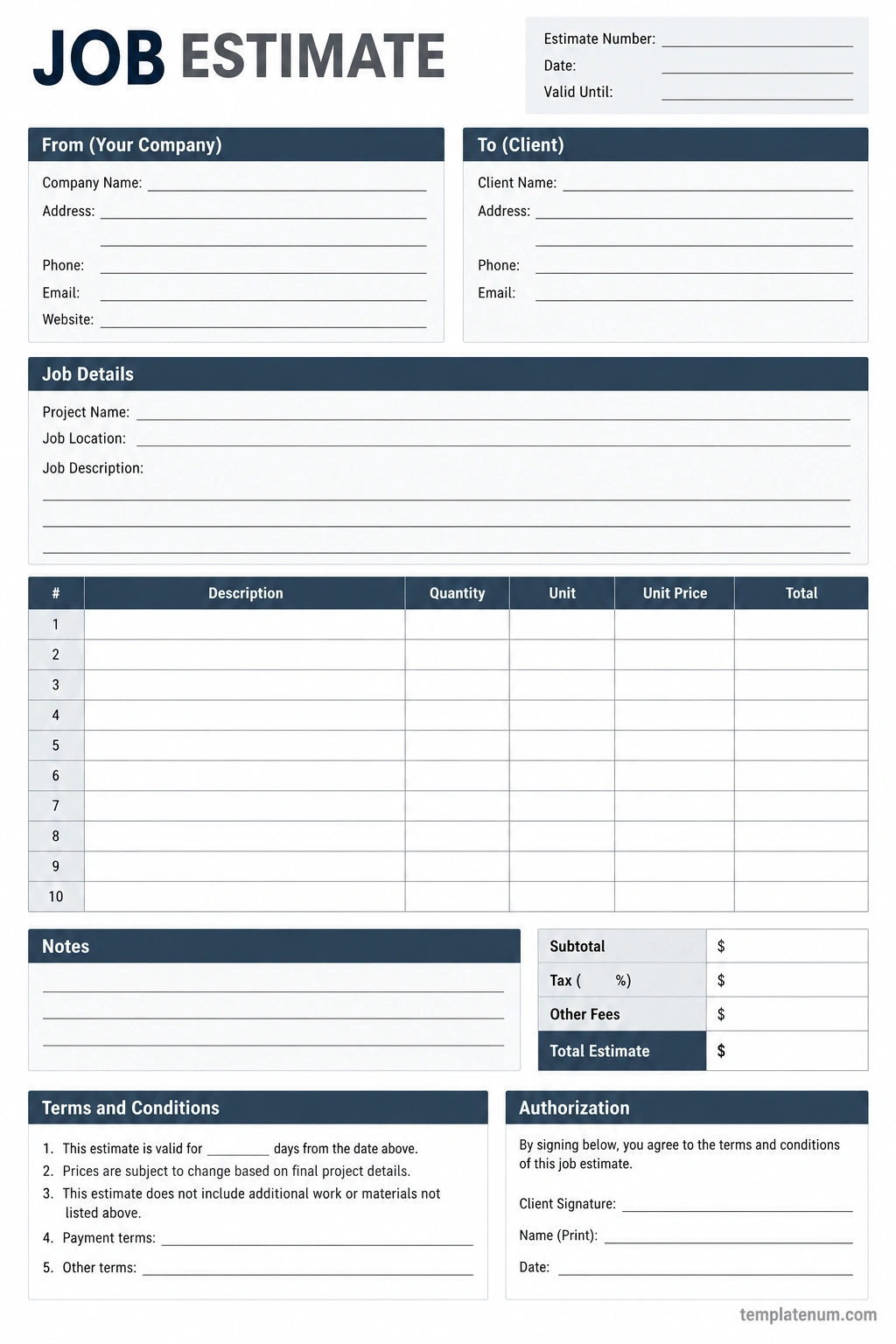
To use the template, fill in the business and client information, describe the work, and list each estimated expense on a separate line. Add the subtotal, applicable taxes, other fees, and total estimate. Complete the terms section before sharing the document with your client.
Keep a copy of every estimate you send. If the scope or pricing changes, issue a clearly identified revised estimate so both parties can distinguish the latest version from earlier documents.
Job Estimate vs. Quote vs. Invoice
Although these documents may contain similar information, they serve different purposes. Understanding the difference helps you choose the right document for each stage of a project.
- Job estimate: Provides an expected cost based on the information available before the work begins. The final amount may change according to the stated assumptions and agreed change process.
- Job quote: Usually presents a specific price for a defined scope of work. Whether the price is binding depends on the terms, acceptance, and applicable law.
- Invoice: Requests payment for goods or services supplied, according to the billing terms.
Some businesses use these terms differently, so the document’s wording and conditions matter more than its title. Clearly explain whether your estimate is preliminary, subject to inspection, or intended to become part of an accepted agreement.
Tips for Creating a Professional Job Estimate
A useful estimate should be easy to understand, accurate, and tailored to the work being proposed. Follow these practical tips when preparing your document.
- Use clear descriptions: Avoid vague line items that leave clients guessing about the work included.
- Show itemized costs: Separate labor, materials, and other expenses whenever useful.
- State your assumptions: Explain any conditions that could affect the estimated price or completion time.
- Set an expiration date: Specify how long the estimate remains valid, particularly when material prices may change.
- Explain additional work: Describe how changes to the original scope will be reviewed and priced.
- Check every calculation: Verify quantities, rates, subtotals, taxes, and the final estimated amount.
- Maintain organized records: Store estimates using reference numbers, client names, dates, and revision details.
- Use consistent formatting: Include your business branding and contact information so clients can identify the document easily.
Before sending an estimate, read it from the client’s perspective. They should be able to understand what the job involves, what the estimated price covers, and what happens if the project requirements change.
Frequently Asked Questions About Job Estimates
Is a job estimate free?
Many businesses provide estimates free of charge, particularly for straightforward projects. However, some jobs require inspections, specialist assessments, or extensive planning that may involve a fee. State any inspection or estimating charges before performing the work.
How do I write a job estimate?
Identify the client and business, describe the scope of work, calculate labor and material costs, add relevant overhead and profit, and include applicable taxes and fees. Finish with the estimated total, validity period, assumptions, and any relevant terms.
What is the difference between a job estimate and a work order?
A job estimate communicates the anticipated cost of a proposed project. A work order typically authorizes, assigns, or documents work to be performed. Some businesses use both documents: the estimate establishes the expected price, while the work order helps coordinate execution.
Can a job estimate change after it is approved?
Changes may be appropriate when the scope, site conditions, material requirements, or other relevant circumstances change. The process should follow the agreed terms and applicable law. Document proposed changes, explain their effect on the price, and obtain any required approval before proceeding.
Should a job estimate include tax?
It should clearly explain how applicable taxes are handled. Depending on your location and the type of service, taxes may be included in the displayed total or listed separately. Verify the rules that apply to your business and identify any taxes or fees that are excluded from the estimate.
Can I use the same job estimate template for different services?
Yes. A general template can work for many types of jobs if you customize the description, pricing categories, and terms for each project. A contractor may need material and labor breakdowns, while a cleaning service may focus on rooms, service frequency, and optional tasks.
Does a job estimate guarantee the final price?
Not necessarily. An estimate generally communicates an expected cost, but its effect depends on the wording, any accepted terms, and applicable law. Clearly state the assumptions and procedures for handling changes. If you intend to offer a fixed price, make that commitment explicit and ensure the terms reflect it.
Conclusion
A professional job estimate helps you communicate expected project costs, plan resources, and establish clear expectations with clients. By including a detailed scope of work, labor and material costs, overhead, profit, taxes, and relevant terms, you can prepare a more useful and reliable estimate.
A printable job estimate template makes the process easier by giving you a consistent format for every project. Customize the document to match your services, review the calculations carefully, and explain how changes will be handled before work begins.
With a clear estimating process and well-organized records, you can present your pricing professionally, reduce misunderstandings, and make better-informed decisions about the jobs your business accepts.
Download: Job Estimate Template
