A single late payment can have a lasting effect on your credit history, especially if you have otherwise maintained a responsible payment record. If you have missed a payment because of an unexpected situation, you may be able to ask your creditor for a second chance by sending a letter of goodwill.
A letter of goodwill is a polite written request asking a creditor or lender to remove a negative mark, such as an isolated late payment, from your credit report as a gesture of goodwill. Rather than disputing the accuracy of the information, you explain the circumstances behind the missed payment and ask the company to consider making an exception.
Although creditors are not required to approve these requests, a well-written letter may help you communicate your situation and demonstrate your commitment to responsible financial management. In this guide, you will learn how to write a goodwill letter, what to include, and how to improve your chances of receiving a positive response.
What Is a Letter of Goodwill?
A letter of goodwill is a formal request sent to a creditor asking for the removal of an accurate negative item from a credit report. It is commonly used when someone has an isolated late payment but has otherwise maintained a positive payment history.
For example, you might have missed a credit card payment because of a medical emergency, temporary financial hardship, an unexpected change in employment, or an issue with an automatic payment. After resolving the problem, you can contact the creditor and request a goodwill adjustment.
The purpose is to encourage the creditor to consider your overall relationship and payment history rather than focusing on one unfortunate incident.
When Should You Send a Goodwill Letter?
A goodwill letter is generally most appropriate when the negative information is accurate, the issue has already been resolved, and you have a reasonable explanation for what happened.
1. An Isolated Late Payment
If you have consistently paid your bills on time but accidentally missed one payment, explain that the incident was unusual and does not reflect your normal financial behavior.
2. Unexpected Personal Circumstances
Unexpected events can sometimes interfere with your ability to make payments. Examples include a medical emergency, temporary unemployment, a family emergency, or another significant personal situation.
3. A Resolved Financial Hardship
If you experienced temporary financial difficulties but have since recovered, explain how you addressed the problem and brought your account back into good standing.
4. A Longstanding Customer Relationship
Customers with a long history of responsible payments may want to emphasize their relationship with the creditor. A positive history can provide useful context for a goodwill request, although it does not guarantee approval.
What to Include in a Letter of Goodwill
A convincing goodwill request should be professional, honest, concise, and respectful. You do not need to write several pages explaining your circumstances. Focus on the information that helps the creditor understand your request.
Include these essential elements:
- Your personal information: Include your full name, mailing address, and contact information.
- Account identification: Provide the account number or another identifier requested by the creditor. Avoid including unnecessary sensitive information.
- Payment details: Identify the late payment by specifying the relevant month and year.
- Explanation: Briefly describe the circumstances that caused the missed payment.
- Resolution: Explain whether the outstanding payment has been made and whether the account is current.
- Positive payment history: Mention your previous record of making payments on time, if applicable.
- Goodwill request: Politely ask the creditor to consider removing the negative entry as a one-time courtesy.
- Appreciation: Thank the recipient for reviewing your request.
Keep your explanation truthful. Do not invent a medical emergency, employment problem, or other circumstance to make your request sound more convincing.
Sample Letter of Goodwill
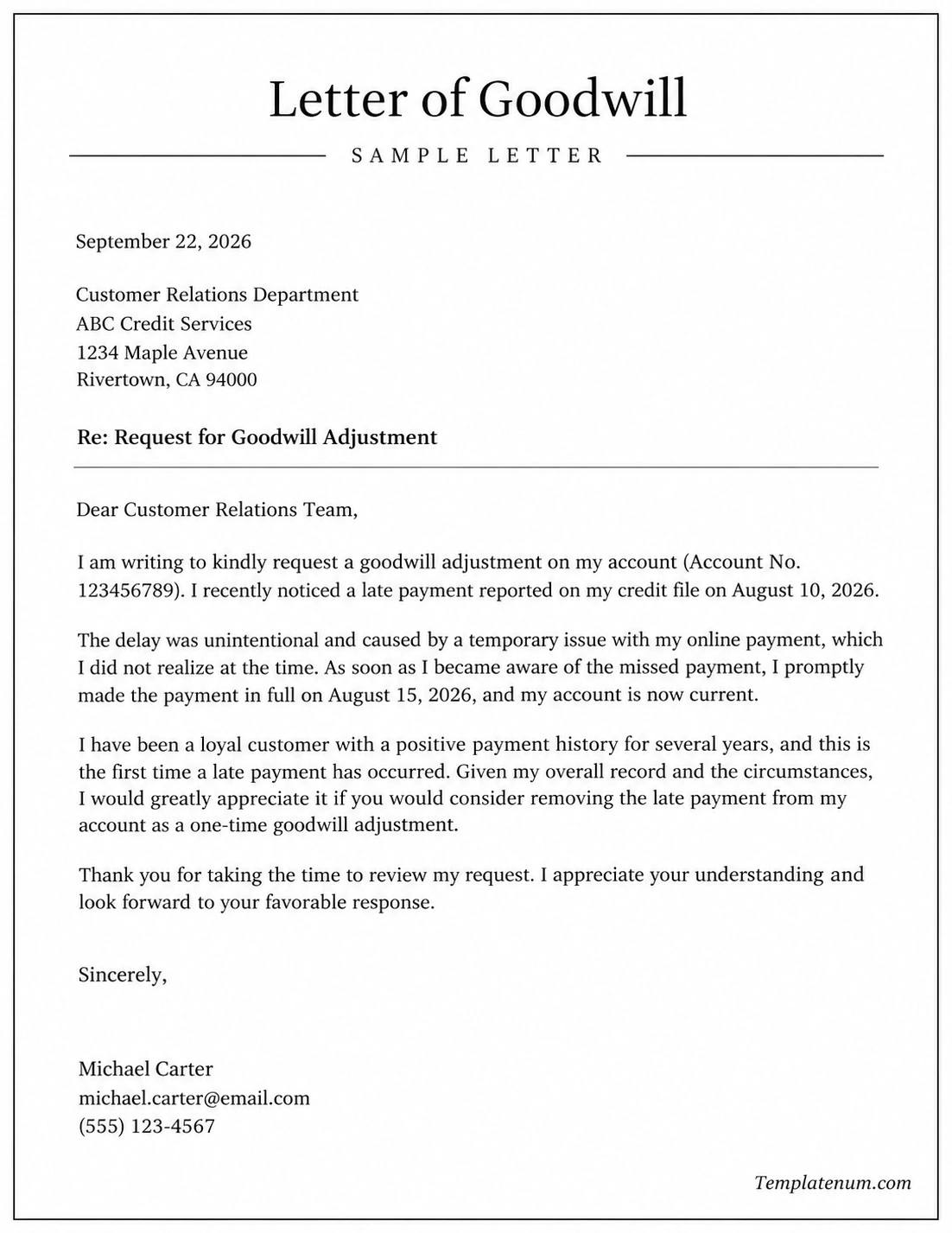
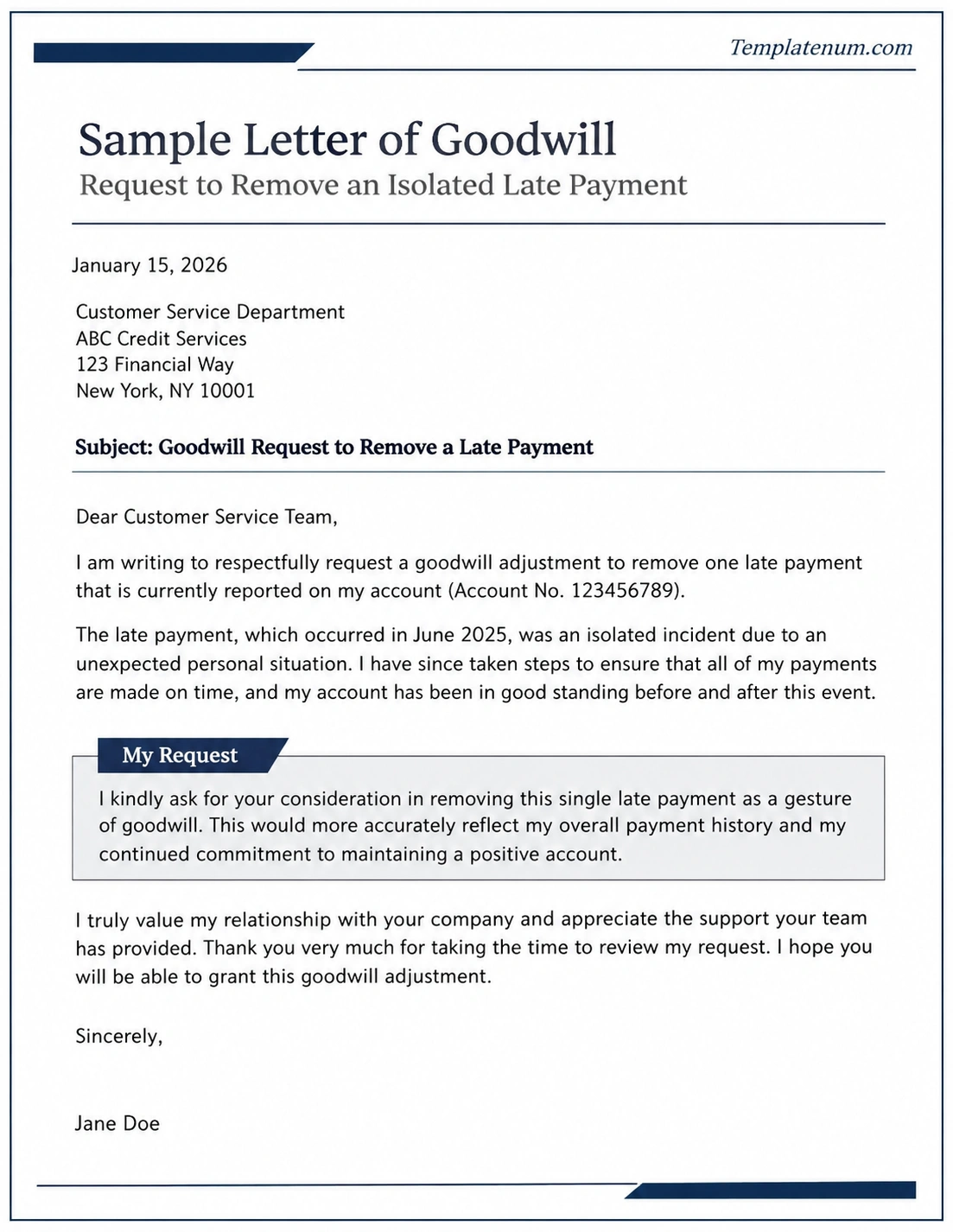
The following sample shows how to request the removal of an isolated late payment. You can personalize it by replacing the example information with your own details.
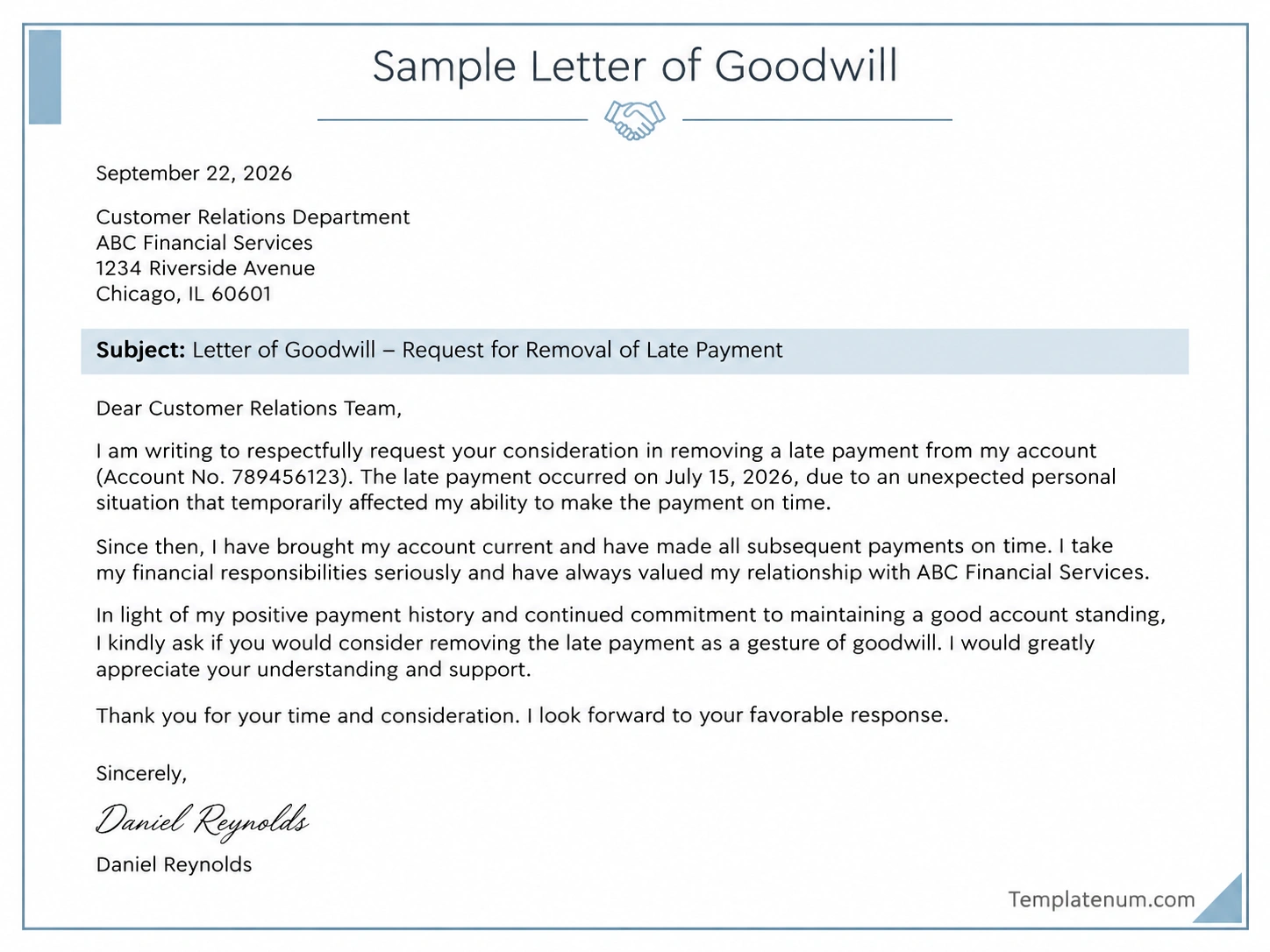
Example Letter
[Your Full Name]
[Your Mailing Address]
[City, State, ZIP Code]
[Email Address]
[Phone Number][Date]
Customer Relations Department
[Creditor or Lender Name]
[Company Address]Subject: Goodwill Request for Removal of Late Payment
Dear Customer Relations Team,
I am writing to respectfully request a goodwill adjustment regarding a late payment reported on my account, ending in [Last Four Digits of Account Number].
The late payment occurred in [Month and Year] due to [Briefly Explain the Circumstances]. Unfortunately, this situation temporarily affected my ability to make the payment on time. Once I became aware of the issue, I took steps to resolve it, and my account is now current.
I have always valued my relationship with [Creditor Name] and have made a genuine effort to maintain a positive payment history. This late payment was an isolated incident and does not reflect my usual approach to managing my financial responsibilities.
Considering my overall payment history and the circumstances surrounding this incident, I kindly ask whether you would consider removing the late payment from my credit reporting as a one-time gesture of goodwill.
I understand that this request is entirely at your discretion, and I sincerely appreciate your time and consideration. Thank you for reviewing my request and for your continued assistance.
Sincerely,
[Your Full Name]
How to Write an Effective Goodwill Letter
Writing a goodwill request does not need to be complicated. However, the way you present your situation can influence how the creditor understands your request.
1. Use a Respectful and Professional Tone
Address the creditor politely and avoid demanding that the company remove the late payment. Remember that you are requesting a discretionary adjustment, not claiming an automatic entitlement.
2. Explain the Situation Clearly
Provide a short explanation of why the payment was late. Focus on the relevant circumstances instead of including unnecessary personal details.
3. Accept Responsibility
If the missed payment was your mistake, acknowledge it. Taking responsibility can make your request sound more sincere and demonstrate that you understand the importance of making payments on time.
4. Highlight Your Positive Payment History
If you have maintained an account for several years without previous late payments, mention this fact. A consistent payment record may help provide context for your request.
5. Explain What You Have Done to Prevent Another Late Payment
Briefly mention any steps you have taken, such as setting up payment reminders, enrolling in automatic payments, or reviewing your monthly billing schedule.
6. Keep the Letter Short
A goodwill letter should generally fit on one page. A clear explanation and a specific request are more effective than a lengthy personal story.
Where Should You Send a Goodwill Letter?
The appropriate destination depends on the creditor. Some companies have dedicated customer relations departments, while others handle goodwill requests through their general customer service or executive correspondence teams.
Before sending your letter, consider these options:
- Customer service department: Ask whether the company accepts written goodwill adjustment requests.
- Credit reporting department: Some creditors have specialized teams that handle credit reporting concerns.
- Executive customer relations: Certain companies provide an executive correspondence channel for unresolved customer concerns.
- Secure online messaging: If available, use your creditor’s official online account portal to submit your request.
Always check the creditor’s official website or contact its customer service team for the correct mailing address or submission method. Keep a copy of your letter and any response you receive.
Tips to Improve Your Chances of Approval
There is no guaranteed formula for getting a negative credit entry removed. However, a thoughtful approach can make your goodwill request clearer and more persuasive.
- Send your request after bringing the account current, whenever possible.
- Focus on one specific late payment rather than requesting the removal of multiple negative entries at once.
- Emphasize a genuine history of responsible payments, if you have one.
- Explain the steps you have taken to prevent similar problems in the future.
- Use a polite and appreciative tone throughout the letter.
- Follow up professionally if you do not receive a response within a reasonable period.
- Keep your communication consistent and avoid sending repeated messages too frequently.
You may also consider calling the creditor before mailing your letter to confirm the correct department and submission procedure.
What Happens If Your Goodwill Request Is Denied?
Not every creditor will approve a goodwill adjustment. Some companies have policies that limit their ability or willingness to remove accurate payment information from credit reports.
If your request is denied, you still have several options.
Contact the Creditor Again
You may consider submitting one additional, more concise request if you have meaningful new information or believe your original explanation was incomplete. Avoid sending identical requests repeatedly.
Check Your Credit Reports
Review your credit reports to confirm that the reported payment history, dates, and account details are accurate. In the United States, you can obtain free credit reports through AnnualCreditReport.com.
Dispute Inaccurate Information
If you discover an error, such as an incorrect payment date, an account that does not belong to you, or a payment incorrectly reported as late, you can file a formal dispute with the relevant credit bureau and the company that supplied the information.
A goodwill request is different from a credit report dispute. You should only dispute information when you have a legitimate reason to believe it is inaccurate or incomplete.
Goodwill Letter vs. Credit Report Dispute
Although both approaches may involve negative credit information, they serve different purposes.
- Goodwill letter: Requests a voluntary removal of accurate negative information as a courtesy.
- Credit report dispute: Challenges information believed to be inaccurate, incomplete, or unverifiable.
Understanding this difference is important. A creditor generally has no obligation to remove accurate information simply because you request a goodwill adjustment. However, credit reporting disputes are subject to applicable consumer protection laws and investigation procedures.
Frequently Asked Questions About Letters of Goodwill
1. Does a letter of goodwill actually work?
Yes, a goodwill letter can sometimes result in the removal of an accurate late payment. However, approval depends on the creditor’s policies and willingness to make an exception. There is no guarantee that the negative information will be removed.
2. Can I request the removal of a 30-day late payment?
Yes. You can ask a creditor to remove an isolated 30-day late payment as a goodwill adjustment. Explain why the payment was missed, confirm that the account has been brought current, and highlight your positive payment history if applicable.
3. Should I send my goodwill letter by email or regular mail?
Both options may be acceptable, depending on the creditor. Use the official communication channel recommended by the company. If you send the letter by mail, consider using a delivery method that provides confirmation.
4. How long does it take to receive a response?
Response times vary between creditors. Some may respond within a few weeks, while others may take longer. Check the company’s stated response timeframe and follow up politely if necessary.
5. Can I send a goodwill letter for multiple late payments?
You can ask, but multiple late payments may be more difficult to have removed. A goodwill request is generally more appropriate for an isolated incident. Focus on the circumstances and the steps you have taken to improve your payment habits.
6. Will removing a late payment improve my credit score?
Removing a negative payment entry may improve your credit profile and could increase your credit score. However, the actual effect depends on your overall credit history and the scoring model used.
7. Can I write a goodwill letter after paying off my account?
Yes. You can request a goodwill adjustment even after paying off an account. Explain your previous relationship with the creditor and why you are requesting the removal of the late payment.
8. Is a goodwill letter the same as a dispute letter?
No. A goodwill letter asks a creditor to voluntarily remove accurate negative information. A dispute letter challenges information that you believe is incorrect or incomplete. Choose the approach that matches your situation.
Conclusion
A letter of goodwill can be a useful way to ask a creditor for a second chance after an isolated late payment. By explaining your circumstances honestly, acknowledging responsibility, and highlighting your positive payment history, you can make a respectful request for a goodwill adjustment.
Although there is no guarantee that a creditor will approve your request, writing a clear and professional letter is a reasonable first step. Use the sample letter in this guide as a starting point, personalize it with accurate information, and remember to maintain consistent payment habits to support your financial future.
Download: Letter of Goodwill Template Word
