A letter of agreement is a written document that outlines the terms and conditions agreed upon by two or more parties. It provides a clear record of their understanding, responsibilities, and expectations before or during a business arrangement, professional relationship, or personal transaction.
Whether you are working with a freelancer, hiring a service provider, starting a business partnership, or confirming a project arrangement, a written agreement can help prevent misunderstandings. Instead of relying on verbal promises, both parties have a document they can review and refer to throughout their working relationship.
In this guide, you will learn what a letter of agreement is, what to include, how to write one, and how to use a sample letter of agreement to create your own document.
What Is a Letter of Agreement?
A letter of agreement is a formal written document that records the mutual understanding between two or more parties. It explains the purpose of an arrangement and identifies the obligations, expectations, and conditions that each party accepts.
This document is commonly used for business transactions, freelance services, consulting projects, employment arrangements, partnerships, and other professional relationships.
Unlike a lengthy contract, a letter of agreement is generally more straightforward and concise. It focuses on the essential details of an arrangement without necessarily including extensive legal language.
However, a letter of agreement is not automatically nonbinding simply because it is called a letter. Depending on its wording, the parties’ intentions, applicable law, and other circumstances, it may create legally enforceable obligations.
When Should You Use a Letter of Agreement?
A letter of agreement is useful whenever two or more parties need a written record of their shared expectations. It can provide clarity before work begins and help establish a professional understanding.
Here are some common situations where this document may be appropriate:
- Freelance projects: A freelancer and client can document the services, deadlines, payment terms, and project requirements.
- Business partnerships: Business partners can outline their initial responsibilities, contributions, and expectations.
- Consulting services: A consultant and client can confirm the scope of services, project duration, and compensation.
- Independent contractor arrangements: Both parties can record the work to be completed and the conditions of payment.
- Property-related arrangements: Parties can document certain agreed terms before preparing more comprehensive legal documents.
- Personal agreements: Individuals can establish written expectations for straightforward arrangements, provided the document complies with applicable law.
For complicated transactions, significant financial commitments, or arrangements involving substantial legal risks, a more comprehensive contract may be necessary.
What Should a Letter of Agreement Include?
A well-written letter of agreement should be easy to understand and contain enough information to explain what each party has accepted. Although the exact format depends on the arrangement, several essential elements are worth including.
1. Date of the Agreement
Begin with the date the letter is prepared or issued. This helps establish when the written terms were documented and provides a reference for future discussions.
2. Names and Contact Information of the Parties
Identify everyone involved in the arrangement. Include the full legal names of individuals or registered business entities, along with relevant addresses and contact information.
3. Purpose of the Agreement
Explain why the parties are entering into the arrangement. A brief introductory paragraph should describe the project, service, transaction, or relationship covered by the document.
4. Scope of Work and Responsibilities
Describe what each party is expected to do. If the agreement involves professional services, list the specific tasks, deliverables, deadlines, and responsibilities.
Clear responsibilities reduce confusion and help both parties understand what is expected from them.
5. Payment and Compensation Terms
If the arrangement involves payment, specify the total amount, payment schedule, accepted payment methods, and any additional expenses. Include relevant details about deposits, installment payments, or late payment conditions.
6. Duration and Termination
State when the agreement begins and how long it will remain effective. If either party can end the arrangement, explain the required notice period and any applicable termination conditions.
7. Additional Terms and Conditions
Include other provisions relevant to the arrangement. Depending on the situation, these may cover confidentiality, ownership of work, revisions, dispute resolution, or procedures for changing the agreed terms.
8. Signatures of Both Parties
Provide signature lines for all parties involved. Include their printed names, positions when applicable, and signing dates. Signatures help document acceptance of the written terms, although enforceability depends on the circumstances and applicable law.
Sample Letter of Agreement
Below is an example of a simple letter of agreement between a business and a marketing service provider. It demonstrates how the main sections can be organized into a professional document.
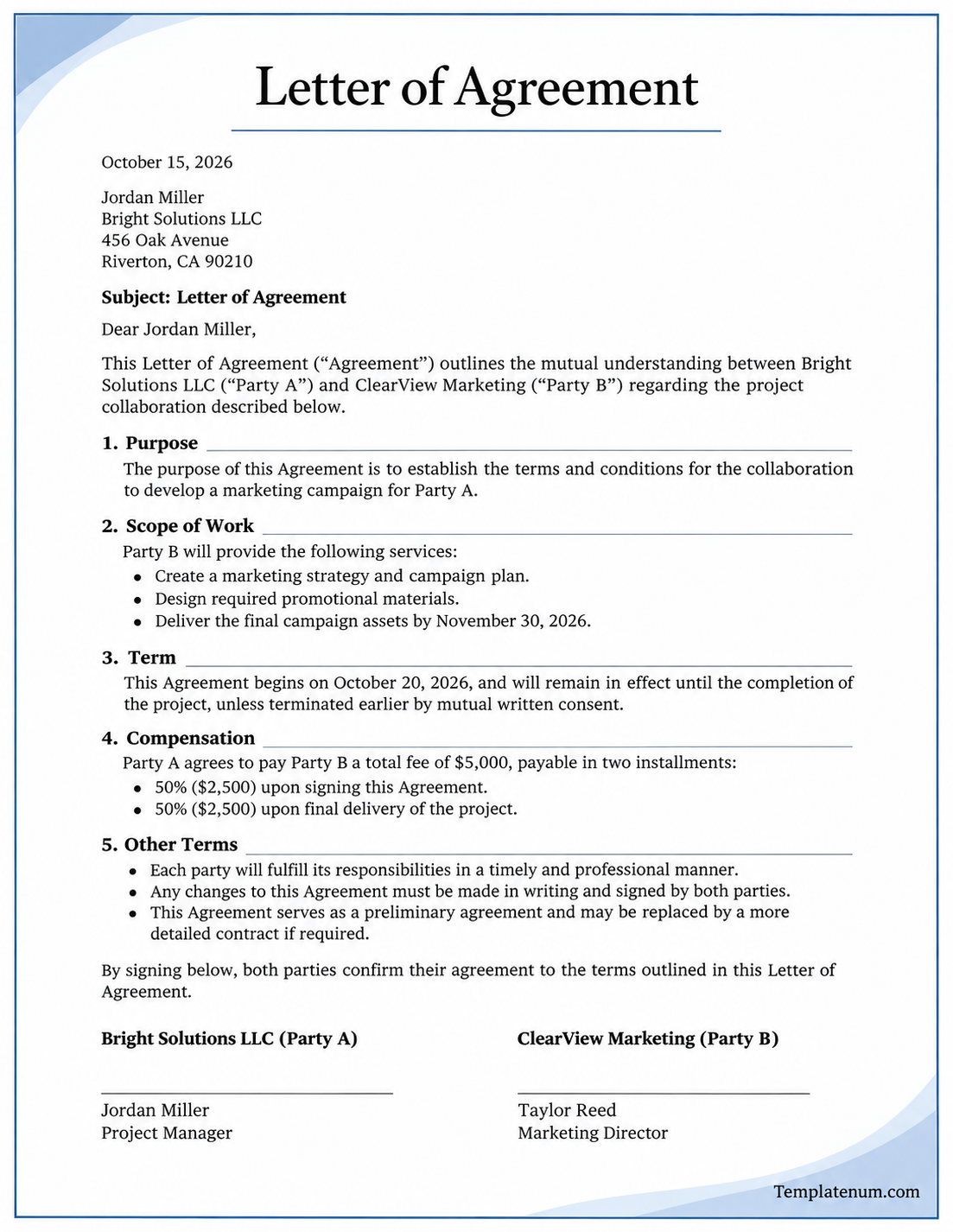
Example Letter
LETTER OF AGREEMENT
Date: October 15, 2026
To: Jordan Miller
Bright Solutions LLC
456 Oak Avenue
Riverton, CA 90210Subject: Letter of Agreement for Marketing Services
Dear Jordan Miller,
This Letter of Agreement outlines the mutual understanding between Bright Solutions LLC (Party A) and ClearView Marketing (Party B) regarding the marketing services described below.
1. Purpose
The purpose of this agreement is to establish the terms and conditions for developing a marketing campaign for Bright Solutions LLC.
2. Scope of Work
ClearView Marketing agrees to provide the following services:
- Develop a marketing strategy and campaign plan.
- Design promotional materials required for the campaign.
- Deliver the final campaign assets by November 30, 2026.
3. Duration
This agreement begins on October 20, 2026, and remains effective until the project is completed, unless terminated earlier by mutual written agreement.
4. Compensation
Bright Solutions LLC agrees to pay ClearView Marketing a total fee of $5,000, payable in two installments:
- 50% ($2,500) upon signing this agreement.
- 50% ($2,500) upon final delivery of the project.
5. Additional Terms
- Both parties agree to fulfill their responsibilities in a timely and professional manner.
- Any changes to this agreement must be documented in writing and accepted by both parties.
- This agreement may be supplemented or replaced by a more detailed contract if necessary.
By signing below, both parties acknowledge that they have reviewed and agreed to the terms outlined in this Letter of Agreement.
Bright Solutions LLC (Party A)
Signature: __________________________
Name: Jordan Miller
Title: Project Manager
Date: ______________________________ClearView Marketing (Party B)
Signature: __________________________
Name: Taylor Reed
Title: Marketing Director
Date: ______________________________Note: This is a fictional example for educational purposes. Replace the names, dates, payment amounts, and other details with accurate information. Review the legal requirements applicable to your arrangement before signing.
How to Write a Letter of Agreement
Writing a letter of agreement does not have to be complicated. The key is to organize the information logically and make every important condition clear to everyone involved.
Follow these steps to prepare your own document.
Step 1: Identify the Parties
Start by identifying all individuals or organizations entering into the agreement. Double-check the spelling of names and the accuracy of business information.
Step 2: Explain the Arrangement
Write a short introduction describing the purpose of the agreement. Avoid vague statements and explain exactly what the parties intend to accomplish.
Step 3: Define Responsibilities
List the responsibilities of each party separately. Include important deliverables, deadlines, performance expectations, and any conditions that could affect the arrangement.
Step 4: Establish Payment and Timeframes
Document the agreed compensation, payment dates, and start and completion dates. If the arrangement does not involve payment, this section can describe other agreed contributions or obligations.
Step 5: Review the Terms and Conditions
Check whether additional provisions are necessary. Consider confidentiality, ownership, cancellation, changes to the arrangement, and dispute resolution where relevant.
Step 6: Obtain Approval and Signatures
Share the completed document with every party for review. Allow sufficient time for questions and revisions before obtaining signatures. Each party should retain a complete copy of the signed agreement.
Tips for Writing an Effective Letter of Agreement
A professional agreement should communicate important information without unnecessary complexity. Keep the following recommendations in mind when preparing your document:
- Use simple language: Write in clear, direct sentences that all parties can understand.
- Be specific: Avoid unclear descriptions of responsibilities, payment conditions, or deadlines.
- Keep the document organized: Use headings, numbered sections, and consistent formatting.
- Address potential disagreements: Include an appropriate process for handling changes or disputes.
- Check all details: Verify names, dates, amounts, addresses, and other important information.
- Keep signed copies: Make sure every party receives the final version for their records.
- Seek legal advice when needed: Have a qualified legal professional review agreements involving significant obligations or potential risks.
Letter of Agreement vs. Contract: What Is the Difference?
A letter of agreement and a formal contract both document the terms accepted by parties. However, they can differ in structure, complexity, and intended use.
A letter of agreement is often shorter and focuses on the essential details of a particular arrangement. It is commonly used when the parties want a straightforward written record of their understanding.
A formal contract may contain more comprehensive provisions, including detailed legal obligations, warranties, liability limitations, indemnification, confidentiality, and dispute resolution procedures.
Importantly, the document’s title does not determine whether it is legally binding. A letter of agreement may be enforceable if it satisfies the relevant legal requirements. Likewise, calling a document a contract does not automatically make every provision enforceable.
The appropriate document depends on the nature of the transaction, the parties’ intentions, the applicable law, and the level of risk involved.
Common Mistakes to Avoid
Even a simple agreement can cause problems if important details are missing or unclear. Avoid these common mistakes when preparing your document:
- Leaving responsibilities undefined: Each party should know exactly what they are expected to deliver or perform.
- Using vague payment terms: Specify amounts, due dates, and payment conditions rather than relying on general promises.
- Ignoring termination conditions: Explain how the arrangement can end and what happens to outstanding obligations.
- Forgetting important dates: Include relevant start dates, deadlines, and signing dates.
- Skipping the review process: Give everyone an opportunity to review the document before signing.
- Assuming every agreement is automatically nonbinding: Consider the actual wording and applicable legal requirements instead of relying on the document’s title.
Frequently Asked Questions About Letters of Agreement
1. Is a letter of agreement legally binding?
A letter of agreement can be legally binding if it meets the applicable legal requirements for an enforceable agreement. Its legal effect depends on factors such as the wording, the parties’ intentions, the subject matter, and the relevant jurisdiction.
2. What is the purpose of a letter of agreement?
Its main purpose is to document the mutual understanding between two or more parties. It outlines their responsibilities, expectations, payment terms, deadlines, and other important conditions to reduce misunderstandings.
3. Can I write my own letter of agreement?
Yes. You can prepare your own letter of agreement for a straightforward arrangement by identifying the parties, explaining the purpose, defining responsibilities, and documenting the agreed terms. For complicated or high-risk transactions, seek professional legal advice.
4. Does a letter of agreement need to be notarized?
Not every letter of agreement requires notarization. The requirements depend on the type of transaction and applicable local laws. Some arrangements may require additional formalities, so check the relevant legal requirements before signing.
5. Should both parties sign a letter of agreement?
Generally, obtaining signatures from all parties is a good practice because it provides written evidence that they reviewed and accepted the terms. The specific signing requirements depend on the type of agreement and applicable law.
6. What is the difference between a letter of agreement and a memorandum of understanding?
A letter of agreement typically records specific terms and responsibilities that parties have accepted. A memorandum of understanding (MOU) generally describes the shared intentions and proposed framework of a relationship. However, either document may have legal consequences depending on its wording and the circumstances.
7. Can a letter of agreement be changed after signing?
Yes, the parties can usually agree to modify an existing arrangement. Changes should be documented in writing, accepted by the relevant parties, and handled according to any amendment provisions in the original document and applicable law.
8. What happens if one party does not follow the agreement?
If a party fails to fulfill an obligation, the other party may have remedies depending on the agreement and applicable law. These may include requesting performance, negotiating a resolution, terminating the arrangement, or pursuing an appropriate legal remedy.
Conclusion
A well-prepared letter of agreement provides a clear written record of the terms and conditions accepted by two or more parties. By documenting responsibilities, payment arrangements, deadlines, and other important provisions, it helps establish realistic expectations and supports a more professional working relationship.
Whether you are arranging freelance services, discussing a business partnership, or confirming a straightforward transaction, take the time to prepare a document that reflects the actual understanding of everyone involved. Review every section carefully, obtain the necessary signatures, and seek legal advice when the arrangement involves significant risks.
With a clear and properly prepared agreement, all parties can move forward with a better understanding of their respective obligations.
Download: Letter of Agreement Template Word
